
In this story11 sections
- What changed in WhatsApp service message pricing India on 1 October
- Service messages, inbound chats and the WhatsApp Business app
- How the 1,000 free replies work for each business phone number
- WhatsApp Business API cost per message in rupees after the free tier
- Utility template charges inside 24 hour window conversations
- GST, BSP platform fees and other charges on top of Meta rates
- How to calculate monthly WhatsApp API bill India shops can expect
- Click to WhatsApp ads and the free entry point window
- Payment method rules and the INR billing deadline for India accounts
- Seven ways to reduce WhatsApp API costs for small business accounts
- Frequently asked questions
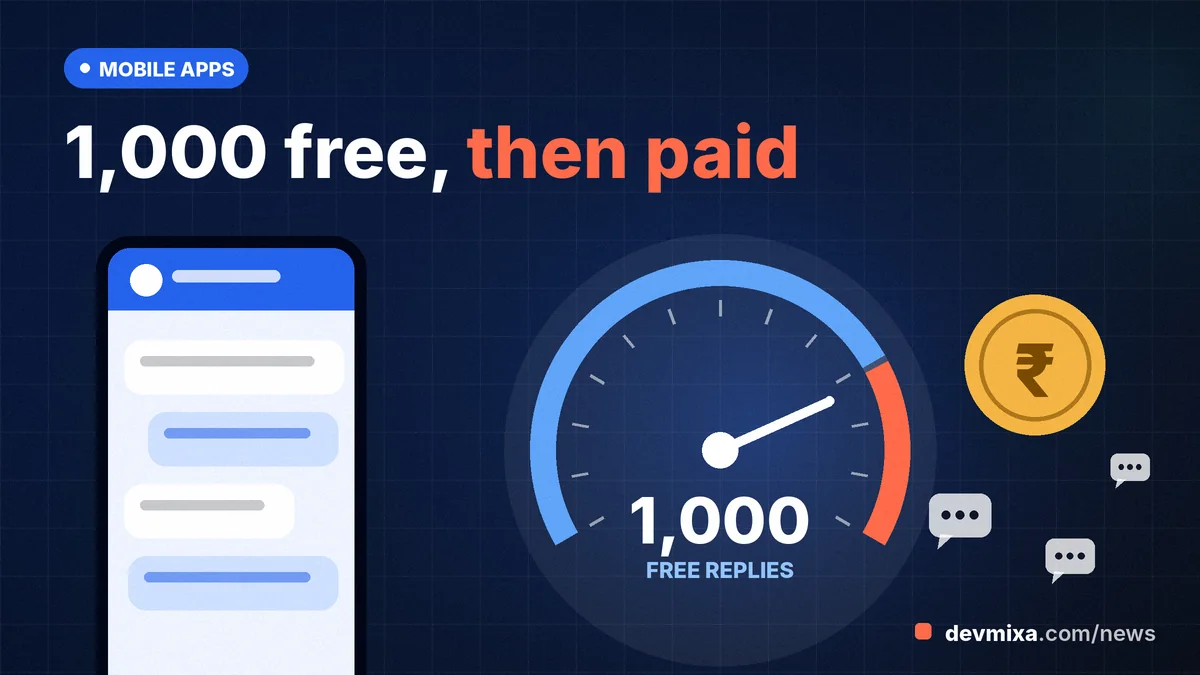
A customer types "Is the blue kurta back in stock?" and your team replies in seconds. Until 30 September 2026 that reply cost nothing on the WhatsApp Business Platform. From 1 October 2026, Meta gives each business phone number 1,000 free delivered replies a month and bills the rest, so under the new WhatsApp service message pricing India rules, a cost teams once ignored now shows up on the monthly invoice.
| Item | Details |
|---|---|
| What changed | Free-form service replies beyond 1,000 per number per month are charged; utility templates sent inside an open customer service window are no longer free |
| Who it affects | Businesses on the WhatsApp Business Platform (Cloud API, directly or through a BSP); personal chats are not affected |
| Key dates | Payment method needed by 30 September 2026; charges live since 1 October 2026; INR migration for eligible India accounts by 31 December 2026 |
| Reported India rate | About ₹0.115 per billable service message, before GST (per reports citing Meta's rate card) |
| Official source | Meta's WhatsApp Business Platform pricing documentation |
| What to do | Check your payment method, count replies per number, review utility template use, and confirm your billing currency |
What changed in WhatsApp service message pricing India on 1 October
Two free lunches ended on 1 October 2026: unlimited service replies and free utility templates inside the 24-hour window. Since November 2024, service conversations had been free for every business. That meter is now switched on, after a generous first stretch.
Under the current rules, each business phone number gets 1,000 free service messages per calendar month. Message number 1,001 is billable. Meta says the free tier counts delivered messages, and the allowance resets at midnight in the timezone of your Messaging account, which most people still call the WABA. Nothing rolls over, so a quiet August does not buy you a busy October.
The second change is subtler. A utility template, such as an order update or a delivery alert, used to be free if the customer had messaged you in the previous 24 hours. Meta's documentation now lists that pricing type as regular from 1 October 2026, which means those messages are charged like any other utility template.
Marketing and authentication rates for India did not change on that date, according to the Free Press Journal. What changed is the set of messages that sit outside the free zone. The WhatsApp service message pricing India businesses face is therefore less about new prices and more about which replies now count.
Service messages, inbound chats and the WhatsApp Business app
A service message is any free-form, non-template reply a business sends while the 24-hour customer service window is open. The window opens when a customer messages you, and it stays open for 24 hours from their latest message. Inside it, you can type normally, share photos or answer questions without pre-approved templates. Once it shuts, only a template message can reach that customer.
Think of the window as a shop shutter that rises when the customer knocks. Once it drops, only an approved template gets through.
Inbound messages cost nothing. Meta's pricing documentation states that it does not charge for messages a WhatsApp user sends to a business, so a customer who sends ten questions does not add to your bill. Only your outgoing replies count against the 1,000 allowance.
Does WhatsApp Business app charge for messages?
No report or Meta document we checked says the free WhatsApp Business app on a phone is charged under this change. The October pricing applies to the WhatsApp Business Platform, the API used through Cloud API or a provider. A kirana owner replying from the green app on an Android phone is not on the per-message pricing meter. Personal chats between friends and family also stay free.
How the 1,000 free replies work for each business phone number
The WhatsApp API 1000 free service messages per number rule is simple on paper: every business phone number gets its own monthly allowance. Meta's documentation says "each business phone number has one free tier of 1,000 delivered service messages per month," so the count is per number, not per business account or per portfolio.
That detail matters for chains and agencies. Imagine a coaching institute with three branch numbers: it gets 3,000 free replies in total, but each number keeps its own bucket. If the Bhopal branch handles 2,500 replies and the Indore branch handles 300, Bhopal pays for 1,500 even though Indore still has 700 unused. Buckets do not pour into each other.
Three more points are worth knowing:
- Delivered, not attempted: Meta bills only a delivered message, so a reply that never reaches the phone does not use up the allowance or create a charge.
- Monthly reset: the counter resets at 12 am in the Messaging account's timezone, so set that timezone correctly if you track usage in IST.
- No carry-over: unused free replies vanish at month end.
WhatsApp Business API cost per message in rupees after the free tier
The WhatsApp Business API cost per message in rupees now depends on the message category and who sends it. Meta publishes per-message pricing by recipient market on its rate card, and two Indian outlets, the Free Press Journal and IBTimes India, reported the following India figures for October 2026, before tax.
| Message type | Reported India rate (before GST) |
|---|---|
| Service message (after 1,000 free per number) | ₹0.115 |
| Utility templates | ₹0.115 |
| Authentication templates (OTP messages) | ₹0.115 |
| Marketing templates | ₹0.8631 (Free Press Journal) |
| Authentication-international | ₹2.4971 (Free Press Journal) |
So 1,000 extra replies cost about ₹115 before GST. For most small sellers the service line will stay modest. Marketing is a different story: at about 86 paise each, a broadcast to 10,000 customers costs around ₹8,631 before tax.
OTP messages are charged in India at the authentication rate. Authentication-international applies when a business based outside India sends OTPs to Indian numbers. Volume tiers can lower utility and authentication rates for heavy senders, but Meta's documentation says tiers cover only those two categories, and the Free Press Journal reported that service messages get no volume discount. Confirm your exact rate on the rate card or invoice, because these figures come from news reports.
Utility template charges inside 24 hour window conversations
This is the part of the change many sellers missed. From July 2025 to 30 September 2026, a utility template sent while the customer service window was open cost nothing.
That free pass has ended. Meta's documentation says the pricing type for these messages moved to regular on 1 October 2026. In India, that means about ₹0.115 per delivered utility template, based on the reported rate card figures, from the first such message. Unlike service replies, there is no 1,000 free allowance for utility templates.
Should you switch templates to plain replies?
There is a trade-off. If the window is open, a free-form service reply carrying the same order update falls under the 1,000 free allowance, while a utility template does not. For low-volume accounts, a typed or bot-generated reply may now be cheaper than a template. The catch: templates are structured and easy to automate, so switching may need chatbot changes.
Utility templates sent outside the window were already charged and are unchanged. Charged utility messages also count towards volume tiers, which bulk senders should keep in mind.
GST, BSP platform fees and other charges on top of Meta rates
The GST on WhatsApp Business API charges India businesses pay is reported as 18%, added on top of Meta's rates. The Free Press Journal said GST applies over the quoted figures and that providers cite GST 18%. So a ₹115 service charge becomes about ₹135.70 once tax is added. Ask a chartered accountant about input tax credit on these invoices.
Meta's fee is only one layer of the cake. Most Indian small businesses do not connect to Cloud API directly. They use a Business Solution Provider, or BSP, such as AiSensy, Interakt, Gupshup or similar platforms. These companies charge their own subscription or markup.
- Meta message charges: per delivered billable message, set by the rate card.
- GST: reported at 18% on the charges.
- BSP fees: plan fees, wallet markups or per-message margins, which vary by provider.
Do not mix the two. A provider quoting "₹0.20 per message" may be bundling its margin with Meta's fee. Ask your BSP for a breakdown that separates Meta charges from platform fees, and compare it with the rate card.
How to calculate monthly WhatsApp API bill India shops can expect
The method fits on the back of a bill book. Count each billable category, multiply by its rate, add GST, then add your provider's fee.
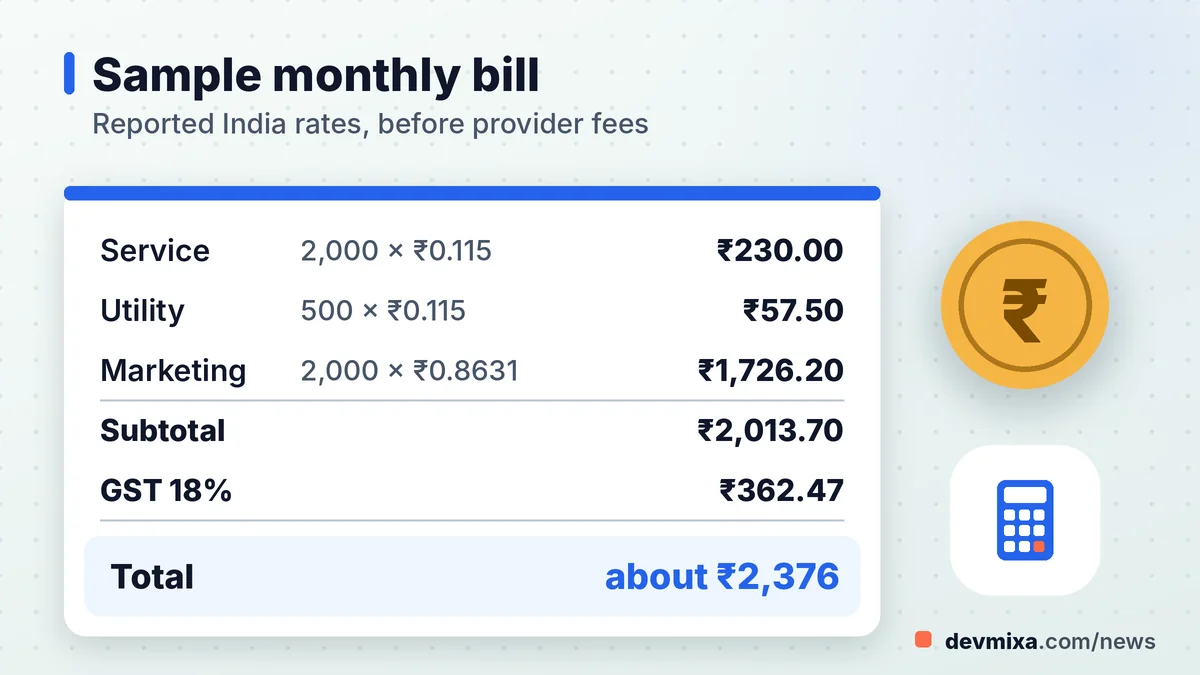
Take an imaginary Bhopal saree store with one business phone number. In a month it sends 3,000 service replies, 500 utility templates inside open windows, and one marketing broadcast to 2,000 customers. Using the reported India rates:
- Service replies: 3,000 minus 1,000 free = 2,000 billable × ₹0.115 = ₹230.
- Utility templates in the window: 500 × ₹0.115 = ₹57.50.
- Marketing: 2,000 × ₹0.8631 = ₹1,726.20.
- Subtotal: ₹2,013.70.
- GST at 18%: about ₹362.47, taking the total to roughly ₹2,376.17.
- Provider fee: add your BSP plan or markup.
Notice where the money goes: the service charge is ₹230, marketing about seven times that. For bigger accounts, the reported examples scale cleanly: 5,000 replies from one number means 4,000 billable, or ₹460 before GST; 50,000 replies means 49,000 billable, or ₹5,635 before GST. Only delivered messages are billed, so failed sends do not inflate the count.
Click to WhatsApp ads and the free entry point window
The free entry point still exists, and Meta's current documentation says the window may stay open for up to 7 days. Many guides still describe the click to WhatsApp ads 72 hour free window, which was the older limit. According to provider Spur, which cited Meta's changelog, the window was extended from 72 hours to up to 7 days on 28 September 2026.
Here is how it works, per Meta. A customer taps a Click to WhatsApp ads button on the Android or iOS app (desktop and web are not supported) and sends a message. If you reply within the 24-hour customer service window, that reply is free and opens the free entry point window from the moment you responded. For as long as that window lasts, every message you send is free, whether it is marketing, utility, authentication or service.
There is one exception. Meta says it continues to charge for Meta Business Agent messages inside the free entry point window, so AI agent replies from Meta's own tool are not covered.
Older Meta pages also listed the Facebook Page CTA button as a free entry point. The latest text we read describes ads only, so confirm the Page button's status in your Meta Business Suite or with your provider before you rely on it.
Payment method rules and the INR billing deadline for India accounts
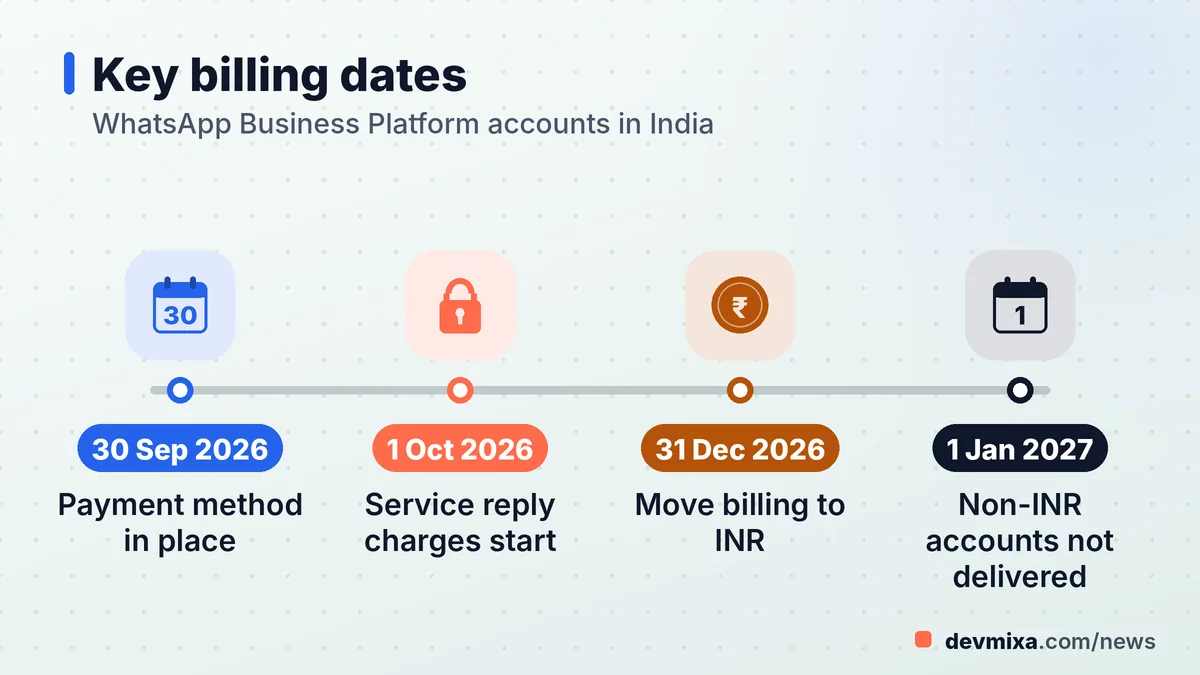
Support desks have heard one panicked search phrase often since October: "WhatsApp API payment method not added service messages stopped". Meta's documentation explains why. Any solution provider or directly integrated business without a payment method on file by 30 September 2026 would find its chargeable service messages undelivered from 1 October. Respond.io reported that Meta confirmed accounts without a payment method still get their 1,000 free service messages; the block hits only the billable ones. If replies stopped mid-month, check the payment method in Meta Business Suite or ask your BSP about your wallet.
Who must move to INR billing, and by when
INR billing launched on 1 January 2026 for solution providers and directly integrated businesses whose Sold-To country is India in Billing Hub. On the WhatsApp API INR billing migration deadline 2026 question, Meta's documentation is firm: every Messaging account in an eligible business portfolio has to be on INR by 31 December 2026. Messages from accounts still billed in another currency will not be delivered from 1 January 2027, Meta says.
If you use a BSP, the provider usually handles this, but ask in writing.
Can Meta change prices again?
Yes. Meta says price changes can take effect only when a quarter begins: 1 January, 1 April, 1 July or 1 October. It promises at least one month's notice for rate card changes and six months for pricing model changes. The next possible date is 1 January 2027, and we found no reported rate card change for that date as of 4 November 2026.
Seven ways to reduce WhatsApp API costs for small business accounts
You can cut the bill without going silent on customers. Treat it like an electricity bill: find the heavy appliance before switching off the fan.
- Confirm your payment method. Check Meta Business Suite or your BSP wallet so billable replies are not blocked.
- Count replies per number. Pull last month's sent and delivered reports and see which business phone number crosses 1,000.
- Merge short replies. Three messages saying "Hi", "Checking" and "Here it is" cost three times one complete reply.
- Use a smart chatbot for FAQs, not for chatter. A chatbot that answers timings, prices and order status in one message saves money. A bot that sends five menus per query burns the allowance.
- Review utility templates in open windows. Where a free-form reply does the same job, it may fall under your free tier.
- Audit marketing broadcasts. This is often the largest line. Send to engaged, opted-in customers rather than the whole list.
- Use the free entry point wisely. If you run Click to WhatsApp ads, reply within 24 hours to open the free window.
So should you use more chatbots or send fewer replies? Neither on its own. The goal is fewer, fuller messages that still answer the customer. Saving ₹100 on replies can lose a ₹2,000 order. If your website, chat widget and WhatsApp flows need rework, a team that handles website development can help connect them cleanly. You can follow more app platform updates in our mobile apps news section, and check the full rules in Meta's WhatsApp Business Platform pricing documentation. Billing and tax rules can change, so confirm details on Meta's official page or with your accountant.
Frequently asked questions
Are WhatsApp service messages free in India now?
Only partly. Since 1 October 2026, each business phone number on the WhatsApp Business Platform gets 1,000 free delivered service messages per calendar month. After that, each delivered service reply is billed. Replies sent inside a free entry point window opened by a Click to WhatsApp ad remain free, and personal chats are not affected.
What is the price of a WhatsApp service message in India?
Reports citing Meta's rate card put the India rate at about ₹0.115 per billable service message, before GST. That is the same reported figure as utility and authentication messages. So 1,000 extra replies cost roughly ₹115 before tax. Check your own invoice or the rate card, as Meta can revise rates each quarter.
Do WhatsApp API messages attract GST?
Yes. Reports and providers say GST at 18% is added on top of Meta's per-message charges, so a ₹115 charge becomes about ₹135.70. Registered businesses should ask a chartered accountant about input tax credit, as treatment depends on how and from whom you are billed.
Does the 1,000 free reply allowance reset monthly?
Yes. Meta resets the free tier every month at 12 am in your Messaging account's timezone. Unused free messages do not carry over, so 400 spare replies in October do not add to November.
Are personal WhatsApp chats charged?
No. The October 2026 pricing applies to businesses using the WhatsApp Business Platform, the API used through Cloud API or a provider. Chats between friends and family on regular WhatsApp stay free. We found no Meta document or report saying the free WhatsApp Business phone app is charged under this change either.
Are failed or undelivered messages counted?
Meta bills only delivered messages, and its free tier counts delivered service messages. A reply that fails to reach the customer should not use up the allowance or appear as a charge. If your provider shows charges for failed sends, ask it for a delivery report and a breakdown of Meta charges versus its own fees.
Do businesses pay for OTP messages in India?
Yes. OTP messages use authentication templates, which reports put at about ₹0.115 each in India before GST. A business based outside India that sends OTPs to Indian numbers pays the higher authentication-international rate, reported at about ₹2.4971. Volume tiers can lower authentication rates for very large senders.
When did the new WhatsApp pricing begin?
The charges began on 1 October 2026. Businesses and solution providers were asked to add a payment method by 30 September 2026. On the same date, utility templates sent inside an open customer service window stopped being free. Marketing and authentication rates for India did not change that day, according to reports.
Does every business phone number get 1,000 free replies?
Yes. Meta says each business phone number has its own free tier of 1,000 delivered service messages per month. A company with three numbers gets three separate allowances. Unused replies on one number cannot cover overflow on another, so track each number on its own.
Where is the official WhatsApp rate card?
Meta publishes the rules and links to its rate cards in the WhatsApp Business Platform pricing documentation on its developer site. Your BSP dashboard or Meta Business Suite billing should show the rates applied. Always prefer these over third-party figures, which may include provider markups.
Planning a website, web app or SEO upgrade?
Tell us what you need. We reply within one working day with a clear plan and price.