


In this story11 sections
- What the 8 October advisory asks of Instagram, YouTube and the rest
- Who signed it, and why an advisory is not a new law
- The February amendment that gives AI content labelling rules India their teeth
- What counts as synthetic content under IT Rules, and what slips outside
- The 3 hour takedown rule for social media India adopted in February
- Upload declarations, metadata and the labels viewers see
- Creators: where the legal duty actually lands
- Brands, ads and the ASCI code that kicks in on 29 December
- If a deepfake of your face starts circulating
- An AI label checklist for Indian content creators and brand teams
- Frequently asked questions
An invented but familiar example: a cricket fan in Indore shares a "live" clip of a stadium fire that actually happened years ago, and it crosses a lakh views within an hour. New Delhi wants platforms to catch exactly that. The AI content labelling rules India applies now have two layers: an IT Rules amendment in force since 20 February 2026, and a MeitY advisory dated 8 October 2026 asking platforms to label or add context to synthetic and misleading posts.
| Item | Details |
|---|---|
| What | MeitY advisory asking social media platforms to identify and label or contextualise manipulated, synthetic or misleading content, on top of the February 2026 IT Rules amendment |
| Who it affects | Directly: platforms (intermediaries). Indirectly: creators, brands, agencies and anyone who uploads |
| Key dates | Rules notified 10 February 2026, in force 20 February 2026; advisory dated 8 October 2026, effective immediately |
| Official source | Ministry of Electronics and Information Technology (MeitY), Cyber Laws Division |
| What to do | Declare AI-made images, audio and video at upload, keep the platform label on, and keep records for client and ad work |
What the 8 October advisory asks of Instagram, YouTube and the rest
The advisory asks every social media platform to apply "enhanced diligence" to false, manipulated or out-of-context content that could disturb public order, and to label it. Read the MeitY advisory 8 October 2026 synthetic content paragraph and one instruction stands out: platforms should "identify and appropriately label/contextualise manipulated, synthetically generated or misleading content", especially when it claims to show a current event.
According to the text reproduced by MediaNama, the advisory lists several asks:
- Watch closely for old or archived photos and videos passed off as fresh news, digitally altered audio-visual clips, and impersonation of public authorities.
- Identify, prevent and avoid promoting unlawful information in the categories the IT Rules 2021 already define.
- Give priority to complaints from authorised government agencies on public order content.
- Run user awareness drives that nudge people to verify before they share.
- Cooperate with law enforcement within the timelines in the rules, and strengthen monitoring, escalation and grievance systems.
All of this is to happen "with immediate effect". Think of it as a referee blowing the whistle louder, not a new rulebook: misinformation dressed up as breaking news now gets the closest watch.
Who signed it, and why an advisory is not a new law
The advisory came from MeitY's Cyber Laws Division under File No. 16(2)/2026-CyberLaws, signed by Joint Secretary Ajit Kumar and addressed to all social media intermediaries, as reported by MediaNama. It cites the IT Act 2000 and the IT Rules 2021 as its basis.
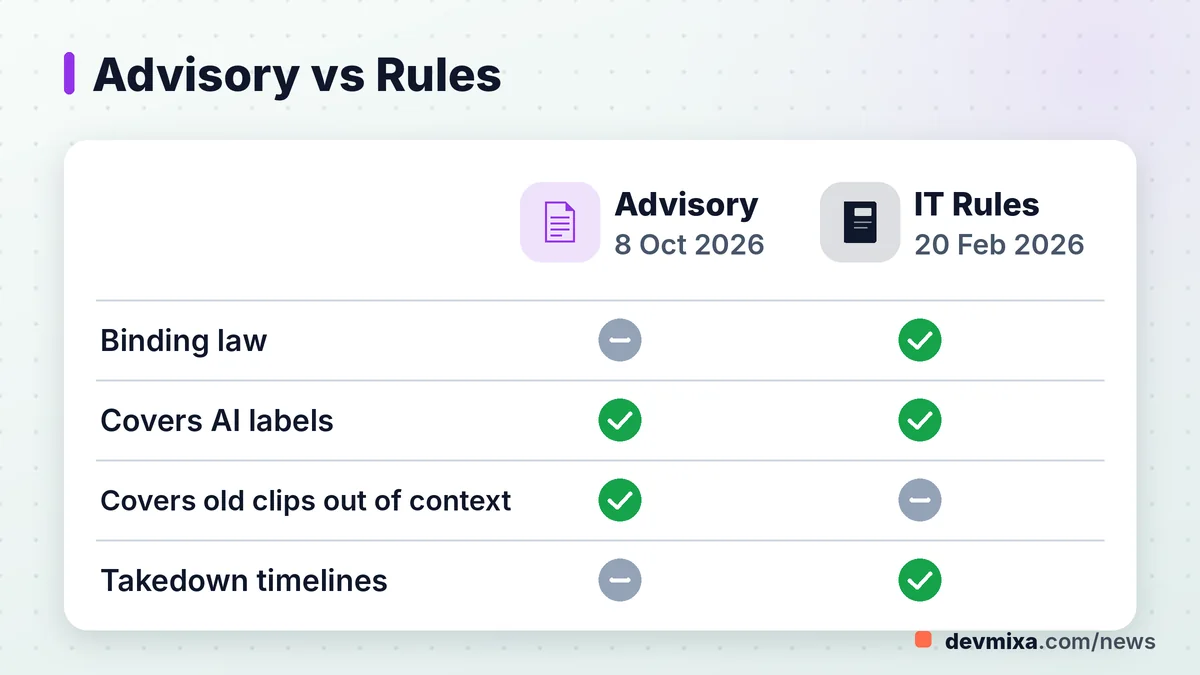
Is it legally binding? Not in the way a notified rule is. An advisory is the ministry stating how it expects platforms to read duties they already have. Platforms tend to comply anyway, because those duties are tied to safe harbour under Section 79 of the IT Act 2000, the shield that protects an intermediary from liability for what users post. Lose the due diligence, risk the shield.
Three points separate the advisory from the February amendment:
- Scope: the advisory reaches misleading and out-of-context content too, such as a real but old photo, which the February definition of synthetic media does not cover.
- Timelines: it does not mention the 3-hour window at all; it points only to the timelines already in the rules.
- Force: the amendment is law, while the advisory is guidance on enforcement priorities.
The law came in February. October brought a memo with a sharper focus.
The February amendment that gives AI content labelling rules India their teeth
The legal backbone of the AI content labelling rules India follows today is the Information Technology (Intermediary Guidelines and Digital Media Ethics Code) Amendment Rules, 2026, notified on 10 February 2026 and in force from 20 February 2026. Platforms got a ten-day window to rebuild their systems.
The IT Amendment Rules 2026 synthetically generated information framework, usually shortened to SGI, puts three duties on platforms:
- Label permitted SGI prominently. Visual content needs a clear visible label; audio needs a disclosure placed at the start.
- Embed permanent metadata or other provenance markers where technically feasible, including a unique identifier linked to the platform tool used to make or alter the content.
- Block tampering. Platforms must not let anyone modify, suppress or remove these labels or markers.
Law firm Khaitan & Co notes that the draft rules had proposed a watermark covering 10% of the screen, and that this was dropped in the final version. That matters to designers: the label must be noticeable, but there is no fixed size quota eating a tenth of your frame.
A significant social media intermediary that knowingly allows rule-breaking SGI is treated as having failed its due diligence obligations, according to Hogan Lovells.
What counts as synthetic content under IT Rules, and what slips outside
What counts as synthetic content under IT Rules is sound, imagery or video that software has made or changed so convincingly that a viewer could take it for a real person or a real event. The test looks at the result, not the tool. A face swap made in a free app and one made with an expensive studio model are treated alike.
Several things fall outside the definition, as summarised by Hogan Lovells and Khaitan & Co:
- Text-only content, so an AI-written caption or blog post is not SGI under these rules.
- Good-faith editing such as formatting, colour adjustment, noise reduction and compression.
- Documents, presentations, educational material, drafts and templates that do not create false records.
- Tools used only for accessibility, clarity, translation or discoverability, without changing the substance.
So is routine photo editing exempt from AI label duties? Mostly yes. Brightening a product shot or removing background hiss is housekeeping. Swapping the model's face or inventing a crowd at your store launch is not.
At the far end sits prohibited synthetic content, which platforms must try to stop altogether rather than label. Khaitan & Co lists child sexual abuse material, non-consensual intimate imagery, obscene content, false documents, content on procuring arms and ammunition, and material that falsely depicts a person or real-world event.
The 3 hour takedown rule for social media India adopted in February
The rule, introduced through the February amendment, requires intermediaries to act on a court order or a reasoned government intimation about unlawful content within three hours of receipt. The earlier limit was 36 hours. A day and a half has shrunk to less than a Bengaluru airport run in traffic.
There is a faster lane too. Nude images shared without consent and morphed intimate pictures, deepfake pornography among them, must now come down within 2 hours rather than 24, according to Khaitan & Co. General user grievances must now be resolved in 7 days instead of 15.
Who must follow the 3-hour window? Every intermediary that receives such an order, not only the giants. That includes hosting firms and smaller platforms that let users post content.
Can a platform remove an AI video without telling you first? Yes, in many cases. When a government or court order arrives, the clock leaves little room for a back-and-forth with the uploader. Platforms also remove content under their own community guidelines. You usually get a notice after the fact and an appeal route through the platform's grievance officer, so keep your original files and drafts. They are your evidence if you need to contest a removal.
Upload declarations, metadata and the labels viewers see
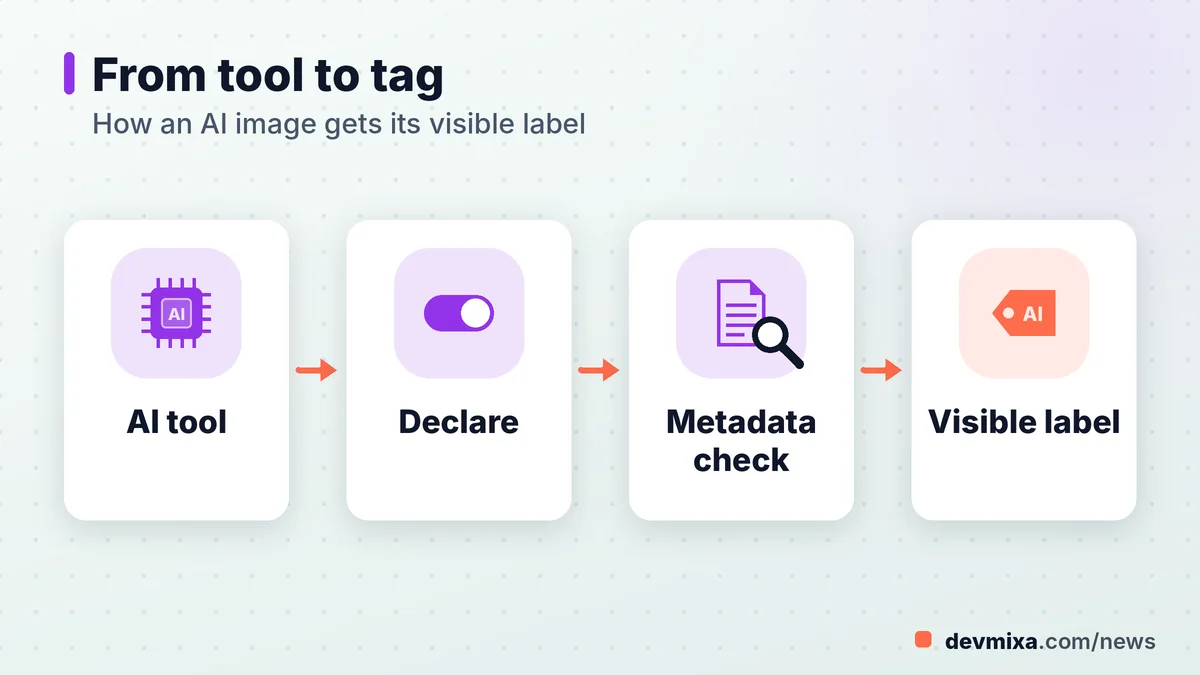
A significant social media intermediary, a platform with more than 50 lakh users in India under MeitY's 2021 notification, must ask uploaders whether their content is synthetic, use technical tools to verify that answer, and label confirmed SGI. The user declaration is now a legal step, not a courtesy box.
Here is how the big three handle it, based on their published help pages. Menus change often, so check the app:
- YouTube: the user declaration of AI content on YouTube India sits in YouTube Studio, as the "Altered or synthetic content" question at upload. YouTube altered content disclosures then appear as a label in the description or, for sensitive topics, on the video itself.
- Instagram and Facebook: Meta shows an "AI info" label. If you are wondering how to label AI generated images on Instagram, use the AI label toggle under advanced settings before posting. The older Made with AI label was renamed after creators complained that minor edits were getting tagged.
Platforms also detect AI material by reading metadata. Provenance markers work like a hallmark on gold: invisible to most buyers, readable with the right tool. Standards such as C2PA, which writes content credentials into a file, record which tool made or edited an image. If an AI tool embeds these credentials, the platform may apply the AI info label even if you forget to.
Creators: where the legal duty actually lands
Creators do not carry a direct statutory duty to label under the February amendment or the October advisory; both are addressed to platforms. The duty reaches you indirectly, through the declaration the platform asks for, the terms you accept, and the advertising code you work under.
That indirect path still bites. If a platform detects undeclared AI content, it can add a label itself, limit reach, remove the post or issue strikes. Imagine a Jaipur creator who posts an unlabelled AI "flood in the city" reel and wakes up to a removed video and a warning.
Any penalty for not labelling deepfake content India imposes under these rules falls first on platforms, which risk losing safe harbour. For individuals, consequences come from older laws. A deepfake that impersonates someone to cheat, invades privacy or defames a person can attract action under the IT Act 2000 and criminal law, depending on the facts. Sections 66D and 66E of the IT Act, on cheating by personation and privacy violations, are often cited in such cases.
Under the October advisory, a reel that presents an old flood or riot video as current is also in scope, even if no AI was used. When in doubt, add the date and place in the caption. For anything that could lead to legal trouble, confirm on the official page or speak to a lawyer.
Brands, ads and the ASCI code that kicks in on 29 December
Brands face a second rulebook from the advertising industry body. The Advertising Standards Council of India (ASCI) released final guidelines on labelling synthetically generated content in advertising on 29 September 2026, effective three months later on 29 December 2026, according to Khaitan & Co and Fox Mandal.
Do brands need to label AI ads India-wide, then? Under the ASCI guidelines, a label is required when synthetic content could materially influence a buying decision and hiding it would mislead. Examples include synthetic influencers or brand ambassadors, demos of products that do not yet exist, and fabricated settings that shape how buyers see a product. AI-generated paid product suggestions must say "Sponsored by [Brand]". ASCI suggests wording such as "Audio/Video created using AI" or "Audio/Video enhanced using AI", and platform labels are acceptable.
Some things stay banned even with a label: fabricated testimonials, synthetic shots that exaggerate results, and anyone's likeness used without consent. Colour correction, decorative effects, AI ad copy and subtitles do not need a label.
This sits on top of the older influencer disclosure rules, which already require tags such as #ad on paid posts. Agencies should add an "AI used?" field to every brief and approval form, record the tool behind each asset, and get client sign-off on both the visual and its label. A two-minute form beats a two-week complaint. If your ads run on your own site, our website development team can help you build label space into product page templates.
If a deepfake of your face starts circulating
Act fast and keep records, because the law now gives platforms only two hours for intimate deepfakes and three hours on government orders.
- Capture evidence first. Screenshot the post, copy the URL, note the account name, date and time. Do not share the clip further, even to warn friends.
- Report it on the platform. Use the impersonation or non-consensual imagery option, not a generic "spam" flag. Escalate to the platform's grievance officer if the first report stalls; contact details are listed on each platform's India grievance page.
- File a cyber complaint. When fraud, threats or sexual imagery are part of the picture, lodge a report on the government's cybercrime portal (cybercrime.gov.in); the national helpline number is 1930.
- Tell your audience. A short post from your verified account saying "this video is fake" limits the damage.
- Get legal advice if the deepfake is defamatory or used for fraud.
Brands should keep a ready response template and one named person to file reports. Fake pages and clone sites spread just as fast, so keep login access and domain records handy for whoever handles your maintenance and support.
An AI label checklist for Indian content creators and brand teams
This AI label checklist for Indian content creators and small brand teams turns the rules into habits you can follow on every upload. Most of it needs no lawyer.
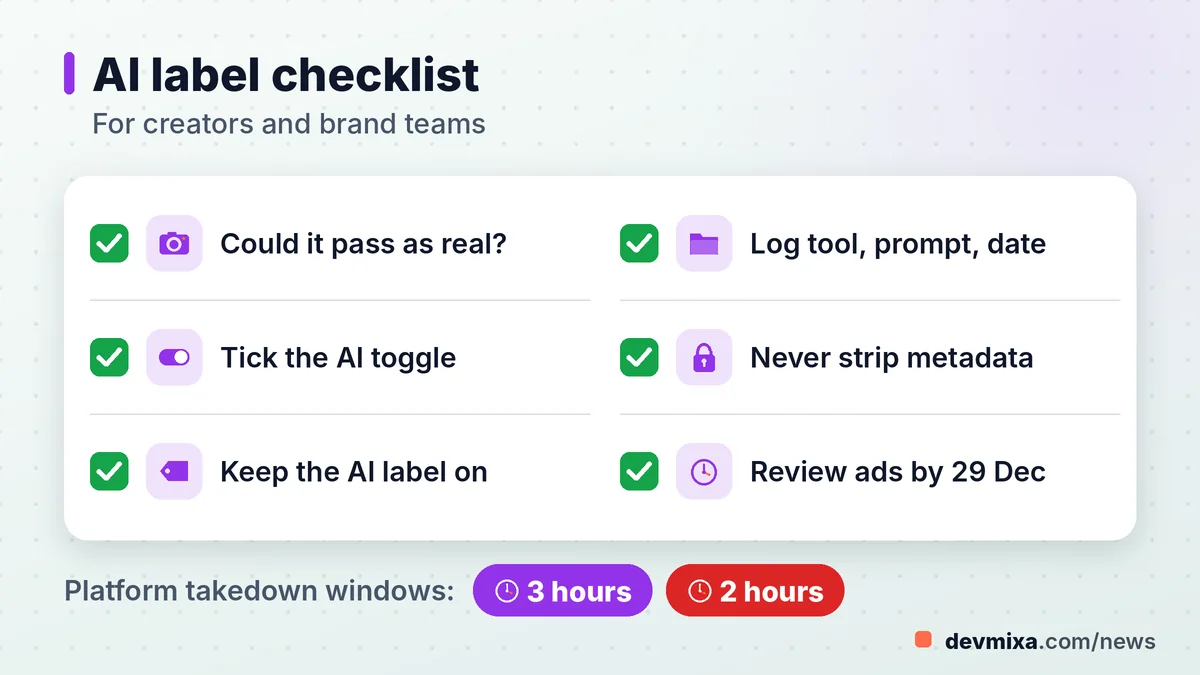
- Ask one question per asset: could a viewer mistake this for a real person, place or event? If yes, it needs a label.
- Use the platform toggle every time. Tick the AI disclosure on YouTube, Instagram or Facebook when the answer above is yes.
- Never strip metadata from AI files to dodge detection. The rules forbid platforms from allowing label removal, and getting caught costs more than the label.
- Add date and place to old footage. The October advisory targets out-of-context clips as much as AI fakes.
- Keep a simple log of the AI tool, prompt and date for each client asset.
- Prepare for 29 December 2026. Review running ad campaigns against the ASCI guidelines before they take effect.
- Get consent in writing before you clone any person's face or voice, including your own staff.
Rules here change quickly, so bookmark the MeitY website for official notifications and recheck before major campaigns. For more coverage of rule changes that affect websites and creators, see our AI news section.
Frequently asked questions
Is AI content labelling mandatory in India?
Yes, for platforms. Since 20 February 2026, the amended IT Rules require intermediaries to label permitted synthetic audio, images and video and embed provenance data. Users face the duty indirectly: large platforms must ask you to declare AI content, and ASCI guidelines will require labels on many AI ads from 29 December 2026.
Does the October advisory cover WhatsApp forwards?
The advisory is addressed to all social media intermediaries, and WhatsApp is one. Because chats are end-to-end encrypted, labelling inside private messages works differently from public feeds, so expect awareness campaigns and forward limits rather than visible AI tags on every message. Report harmful forwards through the app.
Should AI-edited YouTube thumbnails carry a label?
If the thumbnail only has colour fixes or text overlays, no label is generally needed. If it shows a realistic fake scene or a fabricated image of a real person, it can count as synthetic content, and a misleading thumbnail may break platform rules. Declare AI use when a viewer could be fooled.
Is a ChatGPT-written caption covered by the rules?
No. The February amendment covers audio, visual and audio-visual content, and text-only content is excluded from the definition of synthetically generated information. ASCI also lists AI-written ad copy as not needing a label. Normal rules still apply, so a false claim in a caption is a problem whoever wrote it.
How long do platforms get to act on government takedown orders?
Three hours from receipt for court orders and reasoned government intimations about unlawful content, down from 36 hours earlier. For non-consensual intimate imagery, including deepfake pornography, the limit is two hours. These timelines came into force on 20 February 2026 under the amended IT Rules.
Which platforms are treated as significant social media intermediaries?
Any social media platform with more than 50 lakh registered users in India, under the threshold MeitY notified in 2021. Large services such as YouTube, Instagram, Facebook, WhatsApp and X are widely treated as crossing it. These platforms carry extra duties, including collecting and verifying user declarations on AI content.
Must a small business website add AI labels?
A normal business site that only publishes its own content is usually not an intermediary under these rules. ASCI guidelines can still apply to ads and product images that use AI in a misleading way. If your site hosts user uploads or reviews, ask a lawyer whether intermediary duties apply.
Can a creator remove the AI label a platform adds?
Generally no. The amended rules tell platforms not to let anyone modify, suppress or remove labels and provenance markers on synthetic content. If you think a label was added by mistake, for instance on a lightly edited photo, use the platform's appeal or help option rather than trying to strip the tag.
Where is the official MeitY advisory text?
MeitY posts notifications and advisories on its website, meity.gov.in, under its documents and Cyber Laws sections. At the time of writing, the full text of the 8 October 2026 advisory was widely reproduced by MediaNama. Check the ministry site for the official copy before relying on any quoted wording.
Do old photos shared as fresh news need context?
Yes, under the October advisory platforms are asked to give special attention to old or archived photos and videos presented as current events, and to label or contextualise them. Creators should add the original date and place in the caption, even when the image itself is real and unedited.
Planning a website, web app or SEO upgrade?
Tell us what you need. We reply within one working day with a clear plan and price.