In this story11 sections
- Where the IndiaAI Mission GPU tender stands on 6 November 2026
- Inside the C-DAC Request for Empanelment AI compute units clause
- Vaishnaw's 10,000-GPU demand estimate and the 5,000 first tender
- Cluster sizes and data localisation rules for IndiaAI compute providers
- Who could bid, and which providers already serve the portal
- How startups get subsidised GPUs under IndiaAI today
- Eligibility rules for startups, MSMEs, students and researchers
- The IndiaAI compute request approval process monthly cycle
- What is the IndiaAI GPU price per hour in India?
- A founder's checklist before filing a compute request
- Frequently asked questions
Ten thousand chips, one Indian data centre per cluster, and a closed bid box. That is the IndiaAI Mission GPU tender as November 2026 opens. C-DAC published its Request for Empanelment on 7 October, bids closed on 29 October and technical bids opened a day later. For founders, the real news sits next door: subsidised GPU hours are already on offer through a monthly portal cycle.
| Item | Details |
|---|---|
| What | RFE No. C-DAC/GPU/01/2026 to empanel AI service providers for up to 10,000 AI Compute Units (GPUs, TPUs and other AI accelerators) |
| Who it affects | Data centre and cloud firms (as bidders); startups, MSMEs, students, researchers and government bodies (as users of the capacity) |
| Key dates | Published 7 Oct 2026; bids closed 29 Oct 2026, 3:30 pm IST; technical bids opened 30 Oct 2026 |
| Status (checked 4 Nov 2026) | In technical evaluation; no qualified list published; not open for new bids |
| Official source | IndiaAI portal (indiaai.gov.in) and the compute portal, compute.indiaai.gov.in |
| What to do | Founders: check eligibility and file a compute request between the 1st and 25th of the month. Providers: watch C-DAC for evaluation results. |
Where the IndiaAI Mission GPU tender stands on 6 November 2026
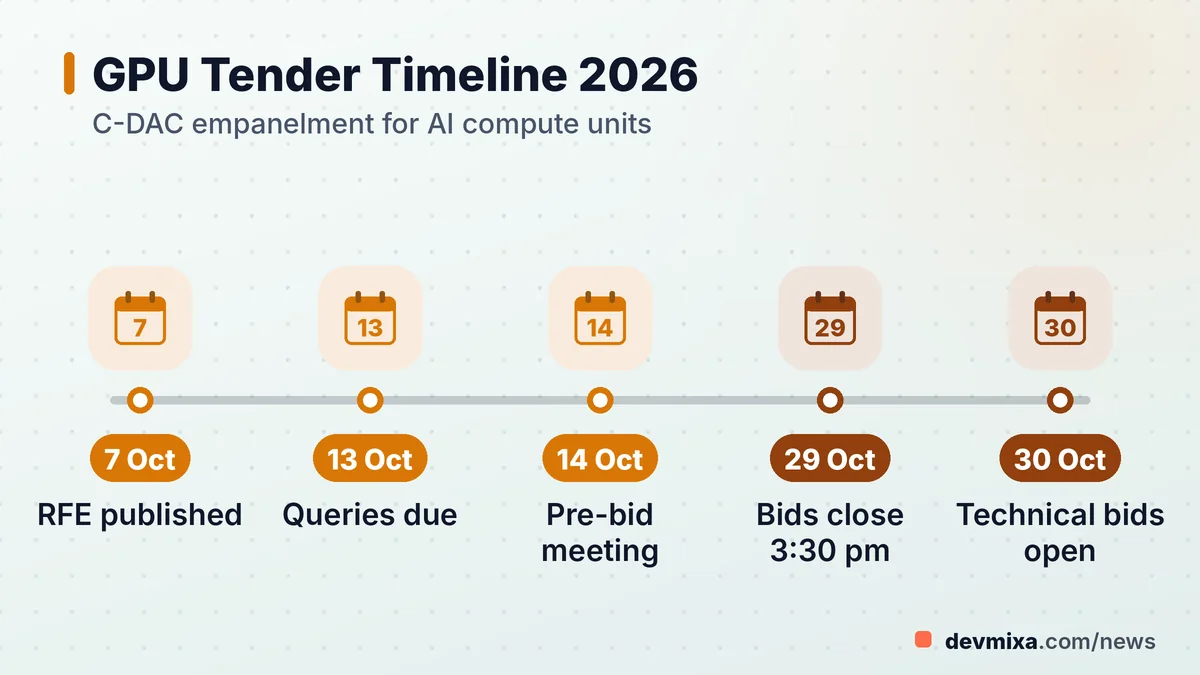
The IndiaAI Mission GPU tender is shut to new bidders and sits in technical evaluation. In October 2026, C-DAC, which works under MeitY, tendered for a fresh panel of AI service providers who can rent out up to 10,000 AI Compute Units to the mission. The paperwork carries the number C-DAC/GPU/01/2026 and went up on the Central Public Procurement Portal on 7 October.
The calendar moved quickly. Pre-bid queries were due on 13 October, an online pre-bid meeting followed on 14 October, and the C-DAC GPU tender bid closing date 2026 bidders had to meet was 29 October at 3:30 pm IST. Technical proposals were opened on the afternoon of 30 October, according to Elets CIO and StartupFeed.
So what happens now? Think of a cricket trial before team selection: every bidder has bowled, and the selectors are scoring. Reports say nobody quotes a price at this stage: firms are scored on technical merit alone, and only those that reach 60 out of 100 make the panel. Commercial terms and cluster allocations come later, in a second stage. StartupFeed reports that Stage-2 buying will run in several rounds through the Government e-Marketplace.
No list of qualified bidders had been published when we checked on 4 November 2026. If you run a data centre and missed the deadline, the IndiaAI Mission GPU tender is closed to you for now; track the official IndiaAI Mission portal for results and the next round.
Inside the C-DAC Request for Empanelment AI compute units clause
An AI Compute Unit, in the language of the C-DAC Request for Empanelment AI compute units clause, is any GPU, TPU, accelerator or similar chip built to run AI workloads. The wording is deliberately chip-neutral. It does not lock the mission into one vendor, though reports say the document names the NVIDIA H100 and H200 and later-generation equivalents, arranged in three power tiers.
Why does a single word matter? Because the mission buys capacity, not boxes. A provider counts its installed AI accelerators, offers them as AI Compute Units, and bills only for what the government side actually takes. StartupFeed reports that billing starts only after C-DAC accepts the infrastructure, and that winners cannot subcontract the service.
The workloads listed are broad: large model training, fine-tuning, inference, high-performance computing and newer AI tasks, as MediaNama summarised the RFE.
Why C-DAC runs the process instead of MeitY
C-DAC is the implementing agency for the compute pillar of the IndiaAI Mission, so it handles the procurement while MeitY sets the policy. The ministry acts like the architect and C-DAC like the site engineer who signs off each pillar. The arrangement keeps tender paperwork, technical scoring and acceptance testing with a body that has decades of supercomputing work behind it.
Vaishnaw's 10,000-GPU demand estimate and the 5,000 first tender
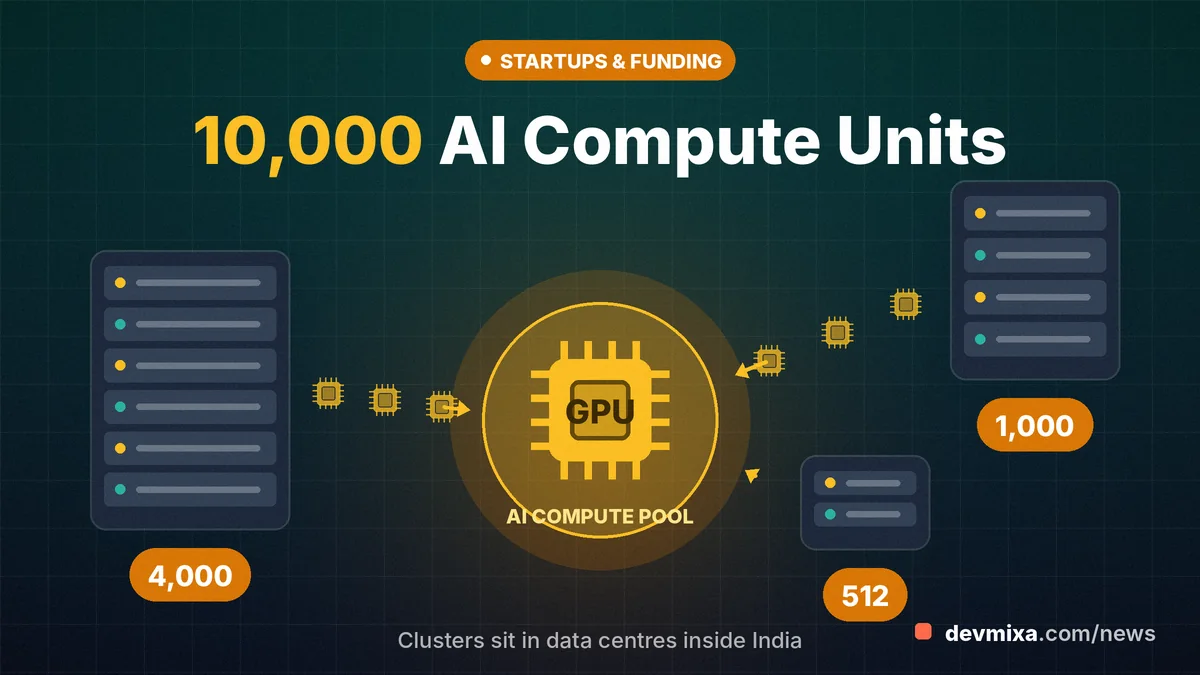
The government estimates demand at 10,000 GPUs and plans to buy the first 5,000. IT and Electronics Minister Ashwini Vaishnaw put it plainly at a World Development Report 2026 event on 8 October, a day after the RFE went live. MediaNama quoted him: "Our demand estimate is for 10,000 GPUs, and the first tender that we are coming out with is for 5,000."
There is a small wrinkle. The RFE itself does not name a first-round quantity, and Elets CIO dates a related ministerial announcement to 11 October. The safest reading is that the minister spoke in early October and that 5,000 is his stated first step, not a figure printed in the tender.
How the new capacity may be shared
Reports of the announcement say 3,000 units would be kept for government and public-interest work, with 7,000 offered to companies. Treat that split as reported, not final, until C-DAC publishes Stage-2 terms. C-DAC can also scale capacity beyond 10,000 units if demand grows.
What earlier rounds already delivered
The new chips land on a pool that is already large. Government communication on the Digital India site says more than 38,000 GPUs have been onboarded on the AI compute portal, under a mission with an outlay of Rs 10,372 crore. The IndiaAI Mission GPU tender extends the shed; it does not lay the foundation.
Cluster sizes and data localisation rules for IndiaAI compute providers
The data localisation rules for IndiaAI compute providers are strict: everything stays in India. MediaNama's reading of the RFE says infrastructure, data, metadata, logs, backups and disaster recovery must all sit on Indian soil, and C-DAC's data must be physically and logically isolated from other customers. StartupFeed adds that the network operations centre and the security operations centre must also be in India.
Clusters come in three sizes: 4,000, 1,000 or 512 units, or as set in Stage 2. Whatever the size, a cluster has to live under one roof, in a single Indian data centre, and the smallest allowed is 512 units. A cluster split across two cities would be like an orchestra playing from two stadiums; the music arrives, but late. Large training runs need chips linked over fast local networks, hence one site per cluster.
What does this mean for a startup using the capacity? Your training data and model checkpoints stay inside the country by design. That helps if you sell to banks, hospitals or government buyers who ask hard questions about data sovereignty. It does not replace your own duties under Indian data protection law, so read your provider's terms and, for regulated data, take legal advice.
Who could bid, and which providers already serve the portal
Only large, India-registered operators could bid. StartupFeed and Elets CIO list the main gates: a company or LLP registered in India, average audited turnover of at least ₹120 crore across FY24 to FY26, positive net worth on 31 March 2026, a Tier-III or better data centre in India, and an ISO 27001 certificate.
Capacity is the hardest gate. A bidder needs 512 compute units already running at one Indian site or, according to StartupFeed, a purchase order backed by a bank guarantee and a commitment to install within six months. The guarantee figure is reported two ways: some summaries say ₹10 crore and others ₹30 crore, possibly for different clauses. We could not read the RFE text to settle it, so bidders should rely on the document and any corrigendum on CPPP. Bidders also signed a Make in India declaration and confirmed they are not from a country that shares a land border with India. The 512-unit floor matches the smallest cluster size, which keeps the door open to mid-sized operators.
Which companies are empanelled IndiaAI GPU providers today
The compute portal shows logos of providers already serving users, including Yotta, E2E Networks (as E2E Cloud), NxtGen, Tata Communications, Sify, CMS, Cyfuture, Ishan, Locuz, Neysa, NTT, Orient and Vensysco. In an earlier round, Inc42 reported that Jio Platforms and Tata also bid. Whether these names return in the 2026 panel is not yet known.
How startups get subsidised GPUs under IndiaAI today
They do not bid at all. They sign up on compute.indiaai.gov.in, prove eligibility, and request GPU hours from capacity that empanelled providers have already put on the pool. The IndiaAI Mission GPU tender fills the reservoir; the portal is the tap.
Picture an imaginary founder, Riya, running a three-person speech-AI startup from Bhopal. She needs no ₹120 crore balance sheet, only DPIIT recognition, proof of AI work, a clear project and a login.
IndiaAI compute portal registration for startups
Registration uses a single sign-on through DigiLocker, e-Pramaan or Jan Parichay, which the portal FAQ also calls Meri Pehchaan. Empanelled organisations get a simpler ID and OTP login. Once inside, a founder fills in an organisation profile, uploads documents, describes the AI use case, and chooses the GPU type and hours needed.
Keep the paperwork in one folder: incorporation certificate, DPIIT recognition, revenue or funding proof, and a short technical note on the model. Most portal delays come from a missing PDF, not a rejected idea. The official portal page is the final word on fields and formats, so confirm there before you file.
Eligibility rules for startups, MSMEs, students and researchers
Startups and MSMEs need DPIIT recognition, AI or ML experience, and either ₹50 lakh in annual revenue or ₹1 crore (₹100 lakh) in funding. Read IndiaAI GPU subsidy eligibility DPIIT startup rules as three gates you must pass together: recognition, experience and money. Missing one gate shuts the other two.
The portal lists other categories, each with its own test:
- Early-stage startups: four years of AI or ML experience, research included, plus a letter from the IndiaAI CEO or an officer of Joint Secretary rank or above.
- Researchers and academia: an h-index of at least 5, or AI/ML publications in journals with an impact factor above 2.5, or 150 or more citations.
- Early-stage researchers: an AI/ML research profile and relevant experience.
- Students: AI or ML projects backed by a matching academic profile; IndiaAI Fellowship students form their own category.
- Government entities: a letter from a Director, MD, GM or authorised officer.
Can students and researchers also get subsidised GPUs?
Yes. Students, researchers and fellowship holders appear as separate user types, so a final-year engineering student with a real ML project is not shut out. For a fresher, a documented GitHub project and a clear compute estimate beat a glossy pitch deck. Criteria can change, so check the live list before applying.
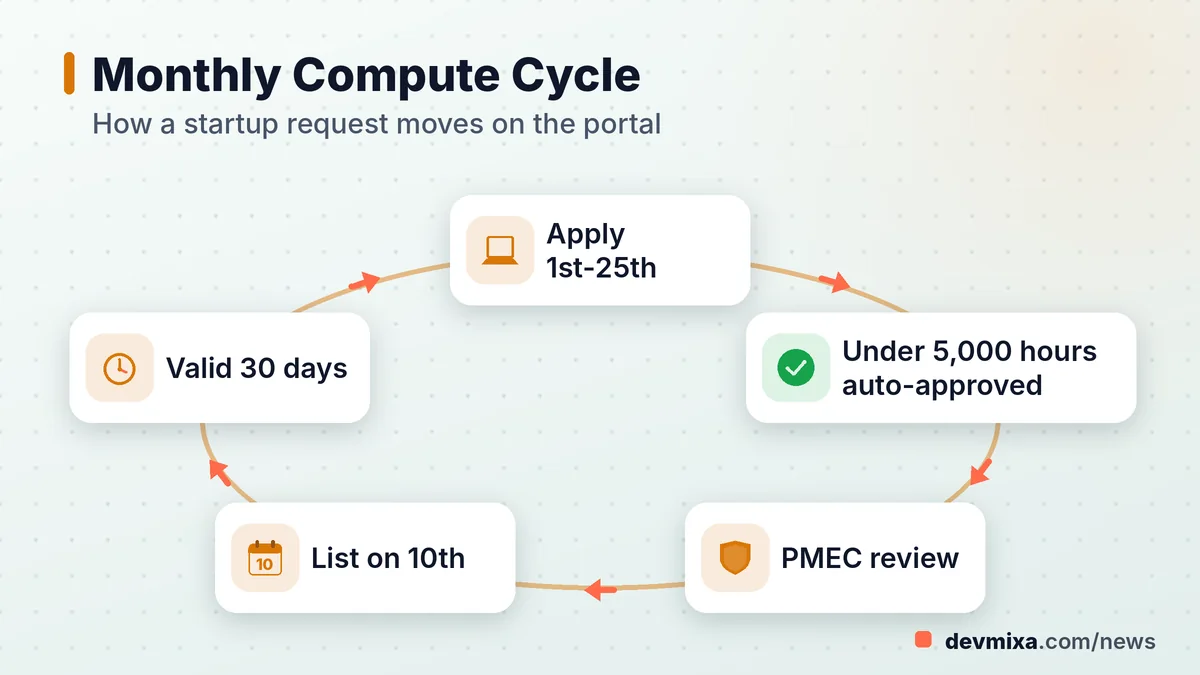
The IndiaAI compute request approval process monthly cycle
The cycle runs on a fixed clock. Requests are accepted from the 1st to the 25th of each month. The approved list is published on the 10th of the following month, or the next working day. A founder who files on 6 November 2026 should therefore expect the list on or around 10 December.
Size decides speed. Requests below 5,000 GPU hours are auto-approved, according to the portal. Anything larger goes to the PMEC, the committee that reviews bigger or unusual asks. Once approved, an allocation is valid for 30 calendar days, and you must start using it within that window. Miss it and the slot lapses, like a railway tatkal ticket you booked but never boarded.
When the PMEC steps in, and what gets priority
PMEC approval matters if you plan a large training run, say several weeks on a multi-node cluster. The portal does not publish a ranked priority list. The RFE names training, fine-tuning, inference and HPC as target workloads, and teams building Indian foundation models have been supported under the mission's own selection track. For a small startup, the practical lesson is to split work into realistic monthly chunks: a 4,000-hour fine-tuning job clears faster than a 40,000-hour wish list.
What is the IndiaAI GPU price per hour in India?
The current rate is shown on the portal's pricing calculator, not as a fixed public list, so check it on the day you apply. The portal says approved projects are subsidised and users pay the balance, but it does not state one percentage for everyone.
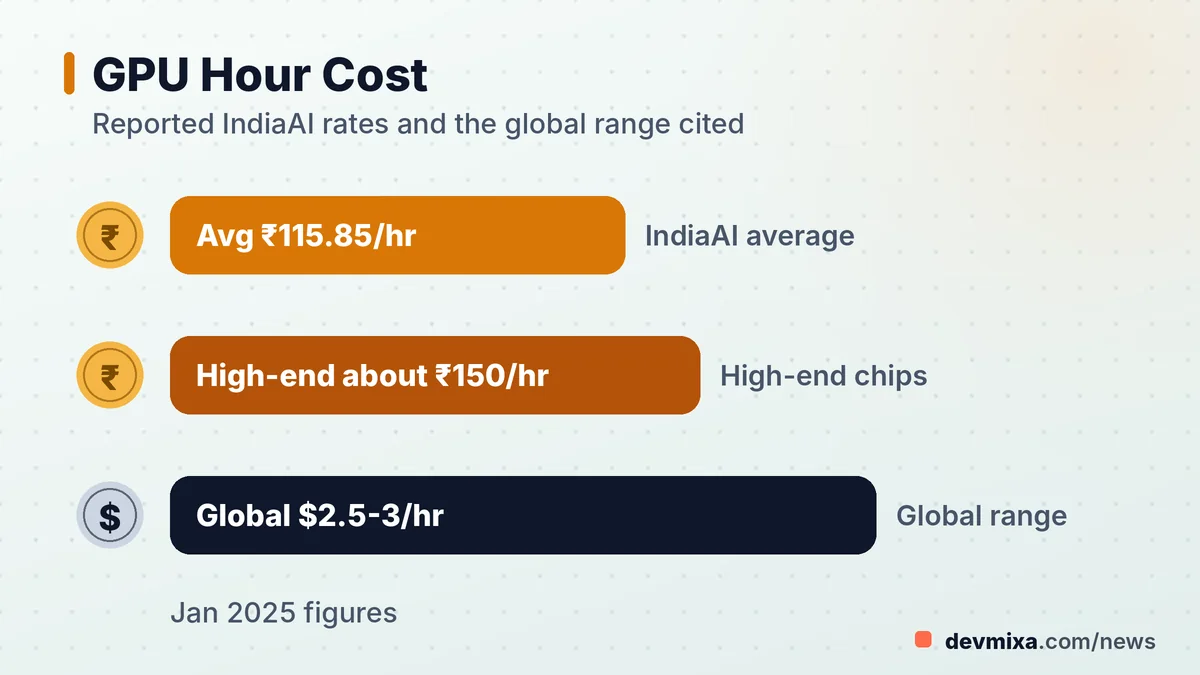
The clearest public numbers are older. In January 2025, Ashwini Vaishnaw said the average cost of AI compute under the mission was ₹115.85 per GPU hour, with high-end chips at about ₹150, as reported by Outlook Business. He also spoke of a 40% subsidy for students, startups and researchers that would take their cost below ₹100 per GPU hour. Those were 2025 figures from an earlier tender, where rates were discovered against the L1 bidder, the lowest quote. They are a guide, not a promise for 2026.
IndiaAI GPU vs AWS Azure cloud cost
The government's own comparison is the only official one: in January 2025 the minister set the mission's rates against a global market range of about $2.5 to $3 per GPU hour. Hyperscaler prices change often and vary by region, commitment and chip, so compare like for like on the day. Count egress fees, storage and support too. A cheap GPU hour is like a cheap flight; the bags can cost more than the seat.
A founder's checklist before filing a compute request
Preparation, not luck, decides most approvals. Work through this list before you open the portal.
- Confirm your category. Check whether you file as a startup, MSME, early-stage startup, researcher or student, and read that category's rules on the official portal.
- Get DPIIT recognition in place. If you are a startup without it, apply first; the compute request will not move without it.
- Keep revenue or funding proof ready. Audited figures for ₹50 lakh revenue, or term sheets and bank records for ₹1 crore funding.
- Estimate GPU hours honestly. Work out the model size, dataset size and epochs, then convert that into hours. Stay under 5,000 GPU hours if you want auto-approval.
- Time your filing. Submit between the 1st and the 25th, and plan for the list on the 10th of the next month.
- Be ready to start within 30 days. Have your code, containers and data pipelines tested before approval, not after.
- Read the provider's data terms. Data stays in India, but your own privacy and contract duties remain.
- Use public datasets wisely. AI Kosh, the mission's dataset platform, can cut collection time for Indian-language and public data.
If your AI product needs a web front end, a dashboard or a site to show investors, plan that build alongside the compute work. Devmixa will report the IndiaAI Mission GPU tender results in our startups and funding news once C-DAC publishes them. For anything legal or financial, confirm on the official page or consult a professional.
Frequently asked questions
Is the C-DAC GPU tender still open?
No. Bids for RFE No. C-DAC/GPU/01/2026 closed on 29 October 2026 at 3:30 pm IST, and technical bids were opened on 30 October 2026. The process is now in evaluation. Providers who missed it should watch C-DAC and the IndiaAI portal for any future round.
How many AI compute units does the RFE cover?
The RFE covers up to 10,000 AI Compute Units, meaning GPUs, TPUs and other AI accelerators. C-DAC may scale beyond 10,000 if demand grows. The minister said the first tender would be for 5,000 GPUs, though the RFE itself does not name a first-round number.
Is IndiaAI GPU access free for startups?
Not usually. The portal says approved projects are subsidised and users pay the balance. In January 2025 the minister cited a 40% subsidy for students, startups and researchers. Check the portal's pricing calculator for the current rate before you plan a budget.
Do I need DPIIT recognition to apply?
Yes, if you apply as a startup or MSME. The portal asks for DPIIT recognition, AI or ML experience, and either ₹50 lakh in annual revenue or ₹1 crore in funding. Students, researchers and government bodies apply under their own separate criteria.
Which login is used on the IndiaAI compute portal?
The portal uses a national single sign-on through DigiLocker, e-Pramaan or Jan Parichay, also described as Meri Pehchaan. Empanelled provider organisations get a simpler ID and OTP login. Keep your Aadhaar-linked DigiLocker account working before you start the request.
How long is an approved compute request valid?
An approval stays valid for 30 calendar days. Users must begin using the allotted GPU hours within that period, or the allocation can lapse. Have your code, data and environment tested in advance so the clock is spent on compute, not set-up.
Are requests under 5,000 GPU hours auto-approved?
Yes, according to the compute portal. Requests below 5,000 GPU hours are auto-approved, while larger requests need PMEC approval. The approved list for each month's requests is published on the 10th of the following month, or the next working day.
What is the total IndiaAI Mission budget?
The IndiaAI Mission has an outlay of Rs 10,372 crore, according to government communication. Compute is one of its pillars, alongside datasets through AI Kosh, foundation models, startup support and skilling. More than 38,000 GPUs have been onboarded so far.
Can foreign cloud providers bid?
Not easily. Bidders had to be companies or LLPs registered in India, run a Tier-III data centre in India, keep all data in the country, sign a Make in India declaration and confirm they are not from a country that shares a land border with India.
How long is the empanelment valid?
Reports disagree. Elets CIO describes a five-year empanelment, while StartupFeed reads the document as a three-year panel listing extendable by three more years, with a five-year service term. Bids stay valid for 180 days. Until C-DAC issues empanelment letters, treat both readings as reported.
Planning a website, web app or SEO upgrade?
Tell us what you need. We reply within one working day with a clear plan and price.