
In this story11 sections
- What starts under DPDP on 13 November 2026, and what stays parked
- Rule 4 builds a consent switchboard, not a website chore
- The Board behind the portal is still filling its chairs
- The DPDP compliance deadline 13 May 2027 has not moved
- No size discount: DPDP compliance for small business website owners
- Writing a DPDP privacy notice for website India visitors can actually read
- Is a cookie consent banner under DPDP Act rules required?
- Under-18 visitors change the sign-up form
- Locks, logs and the 72-hour clock in DPDP data breach reporting for website owners
- Before 13 May 2027: a to-do list for DPDP rules 13 November 2026 website owners
- Frequently asked questions
The calendar flipped to 13 November 2026 and India's privacy law moved forward by one small notch. Among the DPDP Rules 13 November 2026 website owners had circled, only one switched on: companies can now apply to become registered Consent Managers. Your contact form, cookie notice and privacy page carry no new legal duty this week. That duty arrives on 13 May 2027, and the six months in between are the useful part.
On Saturday, 14 November 2026, MeitY announced that eligible Indian companies can apply for Consent Manager registration, according to an ANI report carried by The Tribune. Applications go through the Data Protection Board portal at dpbi.gov.in. Many headlines have blurred two different dates. This follow-up separates them for clinics, coaching centres and online stores.
| Point | Details |
|---|---|
| What changed | Rule 4 of the DPDP Rules 2025, with Section 6(9) and Section 27(1)(d) of the Act, in force from 13 November 2026. Consent Manager registration is open. |
| Who it affects now | Indian companies that want to run a registered consent platform. Ordinary business websites have no new duty yet. |
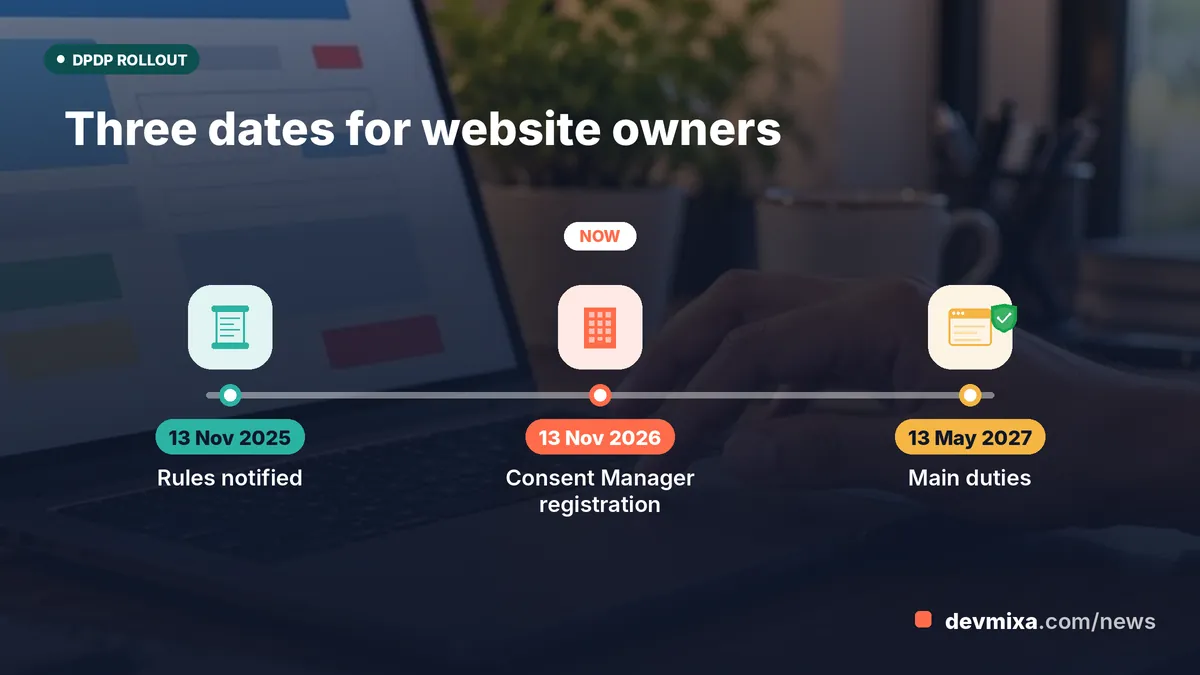
| Key dates | Rules notified 13 November 2025; Rule 4 live 13 November 2026; notice, consent, security, breach and children's rules from 13 May 2027 |
| Official source | DPDP Rules 2025 (Gazette G.S.R. 846(E)) and the Data Protection Board portal, dpbi.gov.in |
| What to do | Map the personal data your site collects, fix forms and notices, check vendors, and keep watching the Gazette for any date change |
What starts under DPDP on 13 November 2026, and what stays parked
What starts under DPDP on 13 November 2026 is a registration system for one kind of company, and nothing more. Rule 1 of the DPDP Rules 2025 said Rule 4 would commence one year after publication in the Gazette. Rule 4 sets out how a company applies to the Data Protection Board to become a Consent Manager.
Two sections of the DPDP Act 2023 came alive with it. Section 6(9) requires every Consent Manager to be registered with the Board, and Section 27(1)(d) lets the Board inquire into one that breaks its conditions. India Briefing reported that applicants must upload 17 documents, each a PDF of up to 8 MB. That is paperwork for platform builders, not for a bakery taking cake orders online.
Everything a typical site owner worries about is still parked. Notice and consent (Rule 3), security safeguards (Rule 6), breach reporting (Rule 7) and data erasure (Rule 8) all begin on 13 May 2027. So do the published contact person (Rule 9), children's data and guardian consent (Rules 10 to 12), Significant Data Fiduciary duties (Rule 13), user rights (Rule 14) and the penalty schedule. A clear date-by-date breakdown is in this commencement table for 13 November 2026.
Think of 13 November as the day the post office opened its counter. The letters you must send are still due in May.
Rule 4 builds a consent switchboard, not a website chore
A Consent Manager is an Indian company, registered with the Board, that gives people one dashboard to give, review and withdraw consent across many businesses. Think of a telephone exchange. It connects the calls but never owns the conversation.
The DPDP consent manager registration Rule 4 framework sets a high entry bar. The First Schedule asks for an Indian-incorporated company with net worth of at least ₹2 crore. Its platform also needs independent certification against standards the Board publishes. The Tribune report on the launch said registered names will be listed on the Board's website.
So does your business website need to register? No. A normal site does not become a Consent Manager by adding a checkbox or cookie plugin.
The difference from a Data Fiduciary comes down to who decides. A Data Fiduciary, such as your booking site or online store, decides why and how the personal data it collects is used. A Consent Manager only carries the user's yes or no to those fiduciaries. In future, a Data Principal might use a registered Consent Manager to manage permissions given to your site, and you would then honour those signals.
The Board behind the portal is still filling its chairs
The Data Protection Board exists on paper, but as of mid-November 2026 public reports did not show a Chairperson or Members in office. The Board was established in law on 13 November 2025, with its strength fixed at four members. MeitY invited applications for the posts on 6 May 2026, and LiveLaw reported on 1 August 2026 that nobody had been appointed.
The picture has shifted a little since then. India Data Law and PPC Land both reported on a Kerala High Court hearing on 7 October 2026. Government counsel said the Board was constituted but not yet working, and the court expected it to begin functioning within about eight weeks. The portal at dpbi.gov.in now accepts applications, yet India Data Law noted that it names no Chairperson or Member.
Why should a website owner in Indore or Bhopal care? Because the Board is the body that will hear complaints, run inquiries and impose penalties once the main duties apply. A referee who has not yet walked onto the field cannot blow a whistle, but nobody should read that as permission to skip practice. The 13 May 2027 date in the Gazette does not depend on appointments.
The DPDP compliance deadline 13 May 2027 has not moved
The DPDP compliance deadline 13 May 2027 still stands, because no Gazette notification changing it had been published by the middle of November 2026. The Rules were notified in the Gazette on 13 November 2025 with an 18-month phased rollout. Rules 1, 2 and 17 to 21, covering the Board's set-up, applied straight away. Rule 4 waited twelve months, while the remaining rules, from Rule 3 onward except Rules 4 and 17 to 21, wait eighteen.
There was a wobble earlier this year. At a MeitY stakeholder meeting on 22 January 2026, a proposal was floated to cut the runway from 18 months to 12, which would have pulled the main duties forward to 13 November 2026. Reports differed on its scope. A change would need an amendment to Rule 1 published in the Gazette, and compliance trackers such as ConsentOS (updated 9 October 2026) found none.
The same date brings the penalty provisions and the repeal of Section 43A of the IT Act. The Act's penalty schedule, as summarised in the government's explainer, allows fines of up to ₹250 crore for failing to keep reasonable security safeguards and up to ₹200 crore for breach-notification and children's data failures.
No size discount: DPDP compliance for small business website owners
DPDP compliance for small business website owners runs on the same law that binds large companies. The Act offers no blanket exemption by turnover or staff strength, and the Rules added no size test. Section 17(3) does let the Central Government exempt notified classes of fiduciaries, including startups, from certain provisions. As far as we could find, no such notification had been issued by mid-November 2026, so plan as if the Act applies to you.
What does a typical site actually collect? More than most owners guess.
Take a hypothetical physiotherapy clinic in Bhopal. Its enquiry form takes a name, phone number and the patient's complaint. Its WhatsApp button opens a chat that reveals a mobile number. Google Analytics records device identifiers, and the payment gateway handles card details.
Every one of those is personal data. Contact form data counts, and so does a WhatsApp enquiry once the number lands in your phone or CRM. Third-party tools usually work as a data processor on your behalf, so the responsibility stays with you as the fiduciary.
Writing a DPDP privacy notice for website India visitors can actually read
Rule 3 sets the shape of a DPDP privacy notice for website India users. It must stand on its own, use clear and plain language, and list each item of personal data with the specific purpose behind it. Section 5(3) of the Act lets users read the notice in English or any of the 22 languages in the Eighth Schedule of the Constitution.
The notice also has to explain how a person can withdraw consent, how they can exercise their rights, and how they can complain to the Board. Add a working email or form for grievance redressal. The government's explainer says fiduciaries must respond to rights requests within 90 days, and a published contact for data questions (Rule 9) closes the loop.
Consent withdrawal deserves real design effort. The Act says withdrawing consent should be as easy as giving it. A one-click unsubscribe link and a simple "delete my data" form meet that spirit far better than "write to our registered office".
A good privacy notice reads like a shop's price board: short lines, no small print. Among the DPDP rules 13 November 2026 website owners can prepare for early, this one costs only an afternoon.
Is a cookie consent banner under DPDP Act rules required?
Neither the Act nor the Rules contain a cookie-specific clause, so whether you need a cookie consent banner under DPDP Act duties depends on what your cookies do. That is our reading of the text, not an official ruling, so check it with a lawyer if your site uses heavy tracking.
A cookie that only keeps a cart full or a user logged in is part of providing the service the visitor asked for. An analytics or advertising cookie that identifies a person and tracks behaviour is personal data processing for a purpose the visitor did not request. The Act wants consent that is freely given, specific, informed, unconditional and unambiguous, shown by a clear affirmative action. A pre-ticked box or a banner that says "by continuing you agree" struggles to meet that standard.
In practice, a fair cookie banner gives "accept" and "reject" buttons the same size and colour, keeps non-essential tags switched off until the visitor says yes, and links to the privacy notice. Many WordPress plugins can do this, but check the settings: several load Google Analytics before the visitor clicks anything. Test your own site in a private browser window and watch which scripts fire on first load.
Under-18 visitors change the sign-up form
The Act treats anyone under 18 as a child, and from 13 May 2027 a website must obtain verifiable parental consent before processing a child's personal data. The DPDP children data parental consent website duty sits in Rule 10, with exemptions in Rule 12. The law also bars tracking, behavioural monitoring and targeted advertising aimed at children, subject to narrow exemptions the government has notified covering things like healthcare, schooling and a child's real-time safety.
Verifiable means more than a checkbox reading "I am over 18". The Rules allow a fiduciary to rely on identity and age details the parent already holds with a trusted source, or on a virtual token such as one issued through DigiLocker.
Picture a hypothetical coaching institute in Jabalpur that takes online admission enquiries for Class 9 and 10 students. Under the new regime, it would need a parent-led flow: the parent fills the form, confirms their own adult identity, and gives consent on the child's behalf. The institute should also stop running retargeting ads on those form pages.
Schools, tuition sites, gaming portals and kids' product stores need the deepest rework, so they should begin first.
Locks, logs and the 72-hour clock in DPDP data breach reporting for website owners
Under Rule 7, DPDP data breach reporting for website owners has two parts. Every affected user must be told without delay, and the Board gets an initial intimation followed by a detailed 72-hour report.
Before any breach, Rule 6 expects reasonable security safeguards. The final Rules name encryption, masking, obfuscation or tokenisation, along with access controls and logs of who opened what. They also ask for backups and for contracts that hold your data processor to the same standard. Keep those logs, and the personal data tied to them, for at least a year so incidents can be traced.
For a small WordPress or PHP site, that means ordinary hygiene done properly. Use HTTPS everywhere and strong admin passwords with two-factor login. Keep themes and plugins updated, keep form entries out of public upload folders, and restore a backup at least once to prove it works. A personal data breach needs no dramatic hacker, because a lead sheet shared with "anyone with the link" is enough.
If your site runs on an old plugin stack, a regular maintenance plan that covers updates, backups and access reviews is cheap insurance. Security and legal duties overlap here, so confirm reporting steps on the official pages or with a professional when an incident happens.
Before 13 May 2027: a to-do list for DPDP rules 13 November 2026 website owners
The honest advice for DPDP rules 13 November 2026 website owners is to start now and spread the work, because nothing new is enforceable today but everything takes longer than it looks. A useful order:
- November to December: list every place your site collects personal data, including forms, chat widgets, booking tools, newsletters and analytics. Note where each record ends up.
- December: delete what you do not need. Old lead spreadsheets and abandoned plugin tables are the easiest risk to remove.
- January: rewrite the privacy notice in plain language, add a grievance contact and a consent withdrawal route.
- February: fix consent on forms (no pre-ticked boxes) and set the cookie banner so non-essential tags wait for a yes.
- March: review vendor contracts for hosting, email, CRM and payments, and ask each about cross-border transfer and breach notice terms.
- April: write a one-page breach plan, test backups and turn on two-factor login for every admin.
- May: check the Gazette and MeitY announcements again before 13 May 2027 in case dates or rules change.
Small sites rarely need expensive software, only a list, a calendar and an owner. Follow later updates on this and other privacy stories in our news section.
Frequently asked questions
How is CERT-In reporting different from DPDP breach reporting?
CERT-In directions issued in 2022 under the IT Act require cyber incidents, including data breaches, to be reported to CERT-In within six hours of noticing them. DPDP breach reporting is a separate duty from 13 May 2027: affected users are told without delay and the Data Protection Board receives an intimation plus a detailed report within 72 hours.
When should a business delete personal data it no longer needs?
Once the purpose is served or the user withdraws consent, and no law requires you to keep it, the data should be erased. Rule 8 also sets specific periods for some large platforms and requires a 48-hour warning before erasure in those cases. Small sites should publish a simple retention period for each kind of data.
Must a website name a person for data questions?
Yes, from 13 May 2027. Rule 9 asks every Data Fiduciary to show contact details for its Data Protection Officer or, where there is none, for someone who can handle questions about how it uses personal data. A small business can name the owner or a manager and give a working email.
Do analytics tools and payment gateways fall under DPDP duties?
Yes. Google Analytics, CRM tools, email platforms and payment gateways usually act as data processors for your site. The Act keeps responsibility with you as the Data Fiduciary, so you should use these tools under a valid contract, collect only what you need, and get consent where tracking is not essential to the service.
From what date can the Board impose DPDP penalties?
Sections 33 and 34 of the Act, along with its Schedule of penalties, take effect on 13 May 2027. The Board also needs appointed members to run inquiries, and reports up to mid-November 2026 showed none in office.
Will Section 43A of the IT Act still apply after May 2027?
No. Section 44(2) of the DPDP Act omits Section 43A IT Act liability, the old compensation route for weak security practices. That change also takes effect on 13 May 2027. Until then, Section 43A and the 2011 security practices rules continue to apply to businesses handling sensitive personal data, so today's security duties remain in place.
How much time does a small website need to get ready?
A simple brochure site with one contact form can often be fixed in a few weeks of part-time work. A site with bookings, payments, logins or children's data usually needs two to four months, because vendor checks, form changes and testing take time.
Which DPDP mistakes do website owners make most often?
Common ones include copying a privacy policy from another site, using pre-ticked consent boxes, loading tracking scripts before the visitor agrees, keeping years of old leads in spreadsheets, and having no named contact for data requests. Another is assuming the plugin vendor carries the legal duty.
Is it safe to wait until May 2027 before changing anything?
Waiting is legal today but risky in practice. The proposal to shorten the timeline in January 2026 showed dates can be revisited, even though no amendment has been notified. Starting early also lets you fix forms and contracts calmly, without a rushed redesign in the last week.
What is the one thing to do this month?
Make a data map. Write down every form, widget, plugin and tool on your site that collects personal data, what it collects, why, where it is stored and who can see it. The privacy notice, the cookie set-up and the breach plan all depend on that list being accurate.
Planning a website, web app or SEO upgrade?
Tell us what you need. We reply within one working day with a clear plan and price.