In this story11 sections
- What DPIIT recognition means and what the February 2026 notification changed
- DPIIT startup recognition eligibility 2026: the age and turnover test
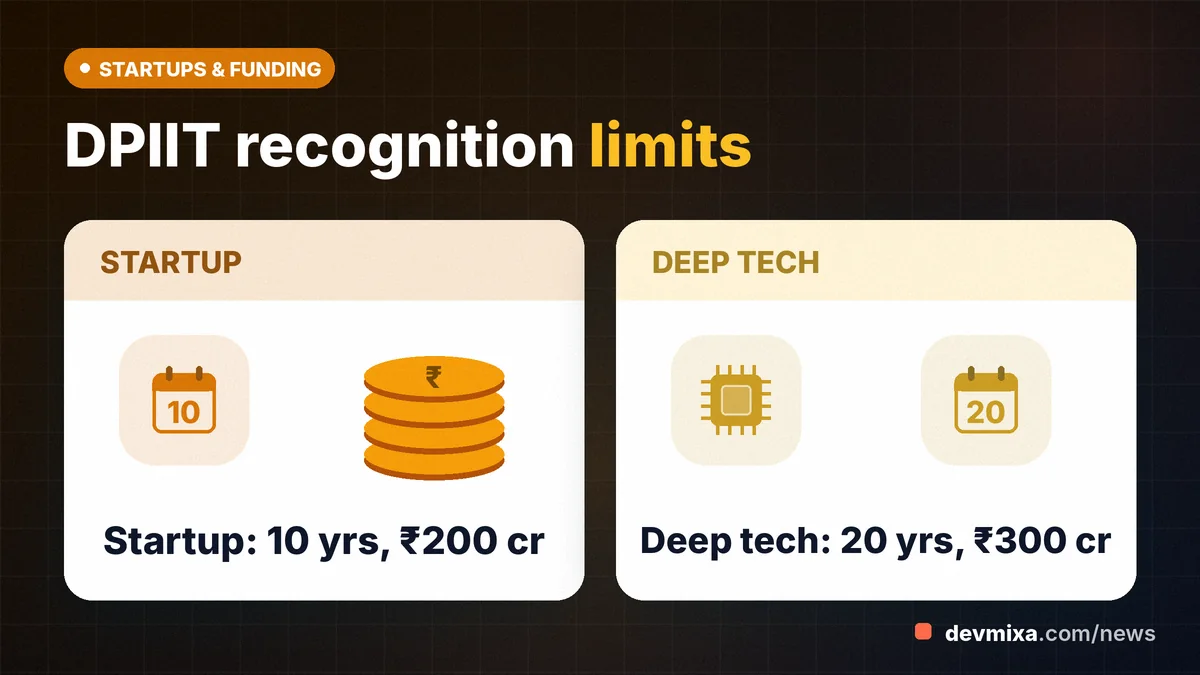
- The new deep tech startup category: 20 years and ₹300 crore
- Which entities can apply, and where sole proprietors stand
- How DPIIT judges innovation and a scalable business model
- Documents required for DPIIT startup recognition
- How to apply for DPIIT recognition online, step by step
- Startup India recognition benefits for small companies
- The Section 80-IAC tax holiday and what happened to angel tax
- Revocation, existing certificates and a checklist for founders
- Frequently asked questions
A founder whose sales were brushing ₹100 crore used to watch the Startup India door swing shut. Not any more. DPIIT startup recognition eligibility 2026 rests on a notification dated 4 February 2026 that doubles the turnover ceiling to ₹200 crore, keeps the 10-year age rule, lets cooperative societies apply and creates a deep tech category allowed 20 years and ₹300 crore. The certificate stays free.
For a software firm in Bhopal or a hardware team in Pune, two questions matter: do we qualify now, and what does the certificate get us? This guide answers both.
| Item | Details |
|---|---|
| What | A new startup definition notified by DPIIT as G.S.R. 108(E), replacing the February 2019 framework |
| Who it affects | Private limited companies, LLPs, registered partnership firms and, for the first time, cooperative societies |
| Key limits | Up to 10 years old and turnover below ₹200 crore; deep tech: up to 20 years and below ₹300 crore |
| Key dates | Notification dated 4 February 2026; Section 80-IAC window open to entities incorporated before 1 April 2030 |
| Official source | Startup India recognition page and the DPIIT gazette notification |
| What to do | Check your age and turnover, prepare an innovation write-up, apply free through the online system |
What DPIIT recognition means and what the February 2026 notification changed
DPIIT recognition is an official certificate from the Department for Promotion of Industry and Internal Trade that says your business counts as a "startup" for government purposes. Think of it as a passport: on its own it takes you nowhere, but without it most Startup India schemes will not let you board. The certificate opens the way to self-certification, cheaper intellectual property filings, tender relaxations, access to seed funds and the right to apply for a tax holiday.
The rules that decide who gets that passport were rewritten this year. Notification G.S.R. 108(E), dated 4 February 2026, supersedes the definition DPIIT notified on 19 February 2019. According to law firms Nishith Desai Associates and Treelife, which have analysed the text, the main changes are these:
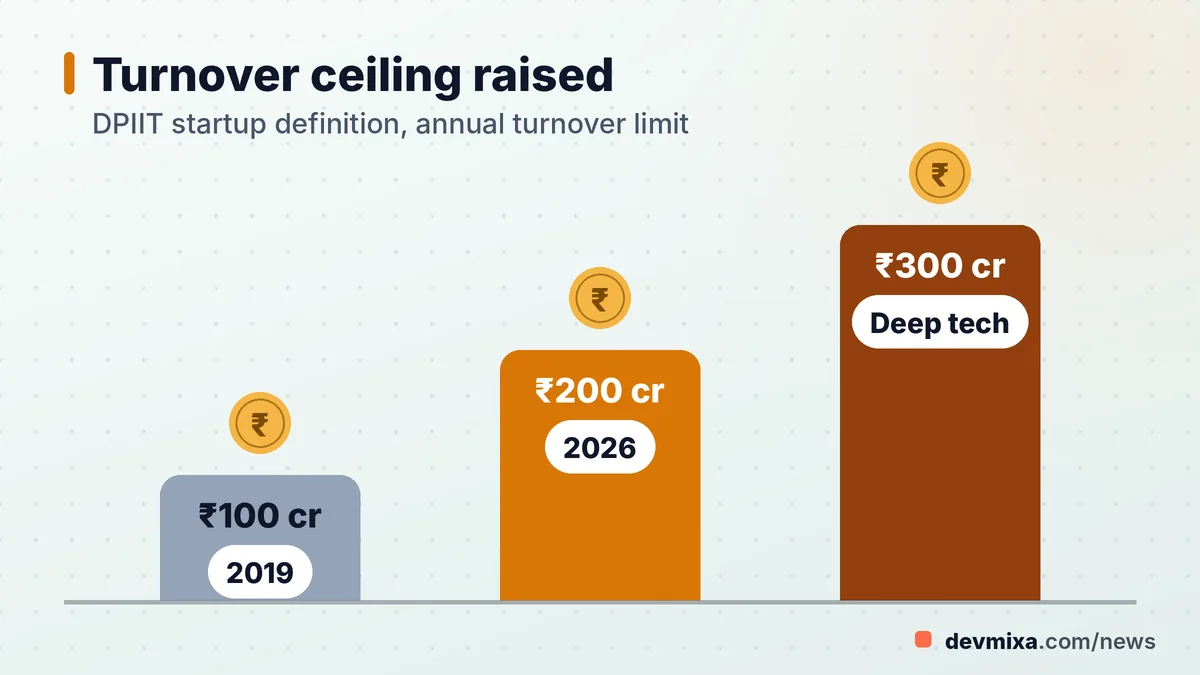
- The turnover ceiling for an ordinary startup rises from ₹100 crore to ₹200 crore in any financial year.
- A separate deep tech startup category gets up to 20 years and a ₹300 crore ceiling.
- Multi-state cooperative societies and those registered under state or Union Territory laws become eligible.
- Recognition can be revoked if it was obtained with false information.
- A new clause lets the government relax or modify conditions for specific classes of startups.
The age limit of 10 years from incorporation did not move.
DPIIT startup recognition eligibility 2026: the age and turnover test
Under DPIIT startup recognition eligibility 2026 rules, an ordinary entity qualifies if it is no more than 10 years old from incorporation or registration in India and its turnover has stayed below ₹200 crore in every financial year since. Both conditions must hold together. A seven-year-old company with ₹150 crore of sales now passes; under the 2019 rules it would have failed on turnover alone.
Notice the words "any financial year". The test is not your latest annual figure but every year since you were formed. If your turnover touched ₹210 crore in one strong year and then fell back, that single year can disqualify you. Founders with lumpy, contract-driven revenue should check every year's audited accounts first.
Age works like a clock that cannot be paused. It starts on the date in your certificate of incorporation (or the registration date for a firm or society) and runs regardless of when you got recognised. A company formed in 2018 that applies in 2026 enjoys only about two more years as a recognised startup.
What happens when you cross a limit
The status lapses once the entity crosses 10 years (20 for deep tech) or breaches the turnover ceiling. There is no renewal filing, so plan benefit claims before the clock runs out.
The new deep tech startup category: 20 years and ₹300 crore
A deep tech startup is a venture whose product rests on new science or engineering, and the 2026 framework gives such firms twice the time and a higher turnover ceiling. Building a battery chemistry, a semiconductor tool or a diagnostic device is a marathon run uphill; the old 10-year window often closed before the first commercial unit shipped.
The deep tech startup recognition criteria DPIIT has notified are based on what a business does, not on a list of approved sectors. According to Treelife and Nishith Desai Associates, an applicant should show:
- products resting on fresh scientific or engineering advances;
- a high share of research and development spending relative to total revenue or funding;
- significant novel intellectual property, held or in the making, with concrete plans to sell it;
- real scientific or technical uncertainty in the path to a working product.
The notification does not define "high". Treelife says a separate DPIIT assessment framework will set how the ratio is scored, so expect case-by-case judgement until that appears. Applicants in this category are expected to submit extra documents, such as patent filings, technical papers and a statement of R&D expenditure.
The prize is meaningful: recognition for up to 20 years from incorporation and a ₹300 crore turnover ceiling. A drone maker that spent its first six years in the lab still has well over a decade of startup status left.
Which entities can apply, and where sole proprietors stand
Four kinds of entity can apply: a private limited company under the Companies Act, 2013, an LLP, a registered partnership firm and, from 2026, a cooperative society. The cooperative addition matters for dairy, agri-processing and rural fintech ventures that chose the cooperative form for its member ownership, whether registered under the Multi-State Cooperative Societies Act, 2002 or a state law.
On DPIIT recognition for sole proprietorship or partnership, the answer splits in two. A registered partnership firm is eligible. A sole proprietorship is not, because the proprietor and the business are legally the same person. A one-person bakery-tech business in Bhopal would first need to incorporate as a private limited company or an LLP, then apply. An unregistered partnership should register under the Partnership Act before applying.
One more exclusion: an entity formed by splitting up or reconstructing an existing business does not count as a startup, the official page says. Rebadging an old company does not reset the clock.
DPIIT recognition vs Udyam registration difference
The DPIIT recognition vs Udyam registration difference confuses many owners. Udyam registration classifies a business as micro, small or medium under the MSME law based on investment and turnover, and it is open to sole proprietors. DPIIT recognition is about age, turnover and innovation. They are separate, both are free, and an eligible startup can hold both.
How DPIIT judges innovation and a scalable business model
Being young and small is not enough; DPIIT also asks whether you are working on innovation, or on improving a product, service or process, with the potential to create jobs or wealth. This is where most rejections begin. A reseller of imported phone covers is a business, but rarely a startup in this sense. A firm that builds software to help those resellers predict stock is a different story.
Reviewers look for three things in your write-up. First, the problem: who suffers, and how badly. Second, the solution: what you do differently from the dozen companies already in the market. Third, the growth path: why the idea can serve many more customers without costs rising in step, which is what a scalable business model means in practice.
Write in short, concrete sentences. "We cut invoice processing time for kirana wholesalers from two days to two hours using a WhatsApp-based tool" beats a paragraph of adjectives. Numbers, early customer names (with permission), pilot results and a short demo video all help.
A patent is not required. What matters is that the novelty is clear on the page, because the officer reading it has no time for riddles.
Documents required for DPIIT startup recognition
The documents required for DPIIT startup recognition are modest, and most will already sit in your company file. The official page only says "support documents" must be uploaded, so the list below is drawn from the application form as described by compliance firms such as Patron Accounting:
- Certificate of incorporation or registration (company, LLP, partnership firm or cooperative society)
- PAN of the entity, and the CIN or LLPIN where applicable
- MOA and AOA for a company, the LLP agreement, or the partnership deed
- An authorisation letter for the person filing, and a board resolution for a company
- A brief on the innovation, its scalability and its potential to create jobs
- A pitch deck or business plan, and a website or app link if you have one
- Proof of concept, prototype photos or a short video, where available
- Details of patents or trademarks filed, if any
- For deep tech applicants: technical documentation, IP filings and an R&D expenditure statement
The innovation brief is the heart of the bundle. Keep it factual, short and easy for a stranger to follow. The later tax holiday filing needs audited accounts and returns, so keep those ready too.
How to apply for DPIIT recognition online, step by step
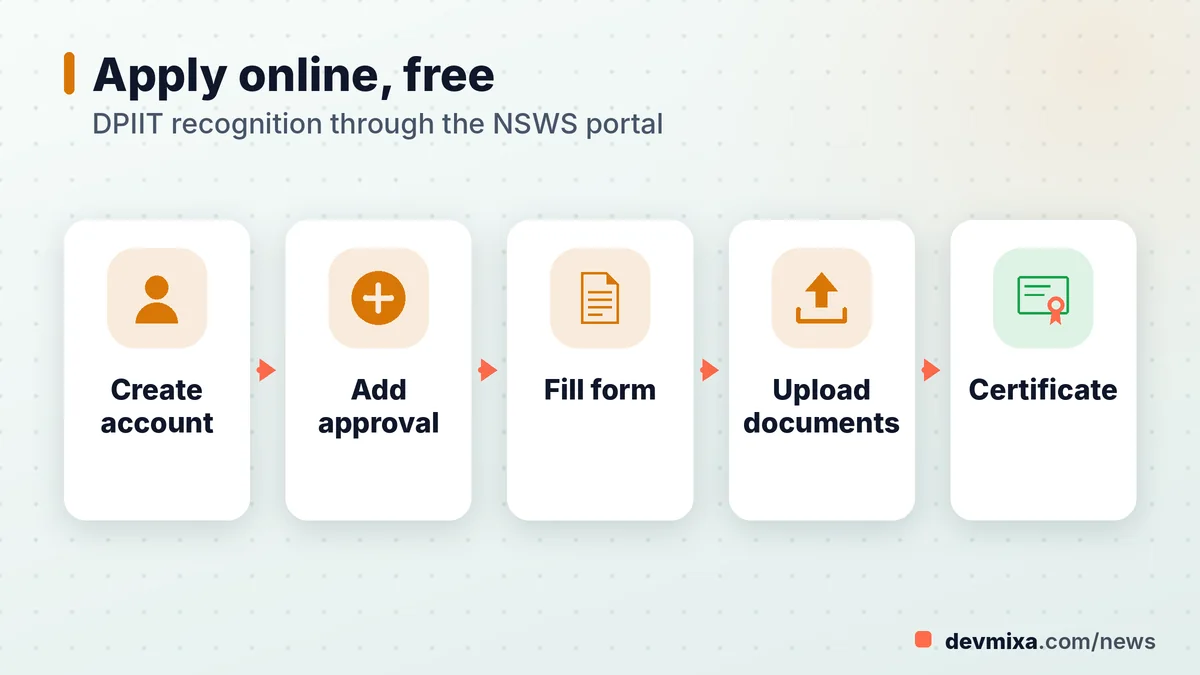
Start at the Startup India portal, which now routes the application through the National Single Window System (NSWS). The official Startup India recognition page lists the steps:
- Create or log in to an investor account on the NSWS portal using a business email.
- On the dashboard, choose "Add Approvals", then "Central Approvals".
- Find "Registration as a Startup" and add it to your dashboard.
- Fill in the entity details, founders, sector and innovation write-up.
- Upload the documents, accept the self-declaration and submit.
The process is fully online, so a founder in Bhopal, Jabalpur or Raipur applies exactly as one in Bengaluru does. No visit to Delhi, no stamp paper, no fee.
DPIIT recognition certificate processing time
The official page does not state a deadline. Compliance firms report a DPIIT recognition certificate processing time of roughly 2 to 10 working days for a complete, clear application. Queries from the officer reset the wait, so answer them quickly.
How to check DPIIT recognition status online
Log in to the same NSWS dashboard, where the application shows as submitted, under query, approved or rejected. Approved certificates can then be downloaded.
Startup India recognition benefits for small companies
The benefits are practical rather than glamorous: lower costs, fewer inspections and a fairer shot at government business.
Self-certification under labour and environmental laws
Recognised startups can self-certify compliance under specified labour and environmental laws for three to five years from incorporation, which generally means no routine inspection without a credible complaint. Guides commonly cite nine labour and three environmental laws, but the list has shifted with the new labour codes, so check the current Startup India page.
Patent fee rebate and IPR fast-track
Under the Startup India IPR scheme, recognised startups get an 80 per cent rebate on patent fees and a 50 per cent concession on trademark fees. Patent applications also qualify for an IPR fast-track examination, and facilitators empanelled under the scheme help with filings at government-borne professional cost.
Public procurement on the GeM portal
In public procurement, recognised startups can seek relaxation from prior turnover and experience conditions in central tenders, and list products on the GeM portal through its startup section, subject to the quality and technical norms of each tender.
Funding and networks
Recognition is the entry ticket for the Startup India Seed Fund Scheme (SISFS), offered through incubators, and indirect access to the Fund of Funds, which invests through SEBI-registered alternative investment funds. The MAARG portal connects founders with mentors, Invest India runs the Startup India hub, and only recognised startups can enter the National Startup Awards.
The Section 80-IAC tax holiday and what happened to angel tax
The Section 80-IAC tax exemption for DPIIT startups is a 100 per cent deduction of profits for any three consecutive years out of the first ten from incorporation, but it is not automatic. Recognition only lets you apply. A separate application goes to the Inter-Ministerial Board (IMB), which examines whether the business is innovative enough to deserve it. The notification lets the Secretary, DPIIT vary the Board's composition.
Three conditions trip people up. Only private limited companies and LLPs qualify, so cooperative societies and partnership firms cannot claim it. The entity must have been incorporated after 1 April 2016. And Budget 2025 extended the incorporation window to startups formed before 1 April 2030. IMB decisions can take months, so file early. Note also that the new Income-tax Act, 2025 replaced the 1961 Act from 1 April 2026; ask your chartered accountant how the startup deduction is numbered and claimed under the new law.
Angel tax is gone for everyone
The angel tax exemption for DPIIT recognised startups used to be a headline benefit. Section 56(2)(viib), which taxed share premium above fair value, was removed by the Finance (No. 2) Act, 2024 for all classes of investors, with effect from 1 April 2025. A recognised startup no longer needs the exemption because the tax itself has been scrapped. Tax rules change; confirm your position with a qualified tax professional before raising funds.
Revocation, existing certificates and a checklist for founders
Yes, recognition can be cancelled. The 2026 notification allows DPIIT to revoke a certificate obtained with false or misleading information, and reports suggest benefits already claimed may then be treated as invalid. According to Nishith Desai Associates, the ban on investing startup money in residential property, luxury assets or speculative instruments now runs through the whole recognition period, not a fixed seven-year window.
Already recognised under the 2019 rules? According to Treelife and other advisers, existing recognised startups do not need to reapply. Check your status and the end date of recognition on your profile anyway; a lapsed certificate behaves like an expired insurance policy, invisible until you need it.
A practical checklist before you apply:
- Confirm the entity type is eligible and, for a sole proprietorship, incorporate first.
- Check the incorporation date and every year's turnover against the 10-year and ₹200 crore limits.
- If you meet the deep tech tests, gather R&D and IP evidence.
- Write a one-page innovation brief with numbers, and refresh your pitch deck.
- Make sure your website or app clearly explains the product; see our website development notes if it does not.
- Apply on NSWS, answer queries within days, and download the certificate.
- If you are a company or LLP, plan the 80-IAC filing with your accountant.
Because the official page may lag the gazette, read the notification text on the DPIIT site and consult a professional for tax and legal decisions. More founder updates sit in our startups and funding news.
Frequently asked questions
Does DPIIT charge any fee for startup recognition?
No. The official Startup India page states that the Ministry charges no fee for the certificate of recognition or the certificate of eligibility, and that it has appointed no agents. Be wary of anyone selling faster approval.
Are Startup India registration and DPIIT recognition the same thing?
Not quite. Registering on the Startup India portal simply creates a profile for your venture. DPIIT recognition is the formal certificate issued after your application is reviewed. Most benefits depend on the certificate, not the profile.
Will recognition alone make my startup tax-free?
No. Recognition only makes a company or LLP eligible to apply for the Section 80-IAC tax holiday. The Inter-Ministerial Board must approve that separate application. Partnership firms and cooperative societies cannot claim it at all.
My company is 11 years old. Can it still apply?
An ordinary startup cannot, because the limit is 10 years from incorporation. The only route is the deep tech category, which allows up to 20 years and ₹300 crore of turnover, but you must show new science or engineering, high R&D spending and significant novel intellectual property.
Do I need a website to apply for recognition?
The analyses we reviewed do not list a website as a mandatory document. The form does ask for a website or app link where available, and reviewers judge innovation largely from what they can see. A clear, working site strengthens the application.
Can a company carved out of an existing business be recognised?
Generally no. The official page says an entity formed by splitting up or reconstructing an existing business is not treated as a startup. The rule stops older firms from creating fresh entities only to claim benefits. A genuinely new venture is judged on its merits.
Is owning a patent a condition for getting recognised?
No. A patent is not needed for an ordinary startup. You must show innovation or meaningful improvement in a product, service or process, plus potential for jobs or wealth. Deep tech applicants are expected to show significant novel intellectual property, which can include filed applications as well as granted patents.
When does DPIIT recognition stop being valid?
Recognition lasts until the entity turns 10 years old from incorporation, or 20 for deep tech, or until turnover crosses ₹200 crore, or ₹300 crore for deep tech, in a financial year. It can also be revoked for false information.
Can a startup from Bhopal or another Tier-2 city apply online?
Yes. The entire process runs online through the National Single Window System, linked from the Startup India portal. A founder in Bhopal, Indore or Gwalior files the same form and gets the same certificate as one in Mumbai, with no visit and no fee.
Should founders still worry about angel tax?
Section 56(2)(viib), the so-called angel tax, was removed by the Finance (No. 2) Act, 2024 with effect from 1 April 2025, for all investors. Older assessments or disputes from earlier years may still be open, so founders with past notices should speak to a tax adviser.
Planning a website, web app or SEO upgrade?
Tell us what you need. We reply within one working day with a clear plan and price.