In this story11 sections
- What Google switched on from 10 November, in plain words
- Check 1: Rule out festive and Black Friday demand before you blame Google
- Check 2: Read Search Console with the dates Google itself suggests
- Check 3: Audit your Google Business Profile after the core update
- Check 4: Local landing pages for Indian small businesses that help, not trick
- Check 5: PHP website SEO after core update, from server to sitemap
- Check 6: Core web vitals for small business websites on budget phones
- Check 7: People-first content and E-E-A-T for a neighbourhood business
- Hands off during the rollout: what to freeze and how long recovery takes
- Your November 2026 core update checklist for small business sites, in order
- Frequently asked questions
A sweet shop in Bhopal, a physiotherapy clinic in Indore and a tiles dealer in Raipur woke up to the same quiet news this month. On 10 November, Google started its third broad ranking reshuffle of 2026. This November 2026 core update checklist for small business owners turns that announcement into seven calm, practical checks you can run on your own site, without guesswork or panic edits.
| Item | Details |
|---|---|
| What | Google November 2026 core update, a broad change to how Search ranks pages |
| Who it affects | All sites, globally, in all languages, including Indian local business websites |
| Key dates | Started 10 November 2026 (10:06 a.m. US Pacific, about 11:36 p.m. IST); Google said it may take up to 2 weeks |
| Official source | Google Search Status Dashboard |
| What to do | Wait for completion, then compare Search Console data and work through the seven checks below |
What Google switched on from 10 November, in plain words
Google released a broad core update to Search on 10 November 2026, and it applies to every country and every language. The Google Search Status Dashboard entry for the November 2026 core update logs the start at 10:06 a.m. US Pacific time, which was late night on 10 November in India, and says the rollout "may take up to 2 weeks to complete".
Google described it on LinkedIn as "a regular update designed to better surface relevant, satisfying content for searchers from all types of sites", as reported by Search Engine Roundtable. It follows the March 2026 update (27 March to 8 April) and the May 2026 update (21 May to 2 June). So this is the third confirmed core update of the year.
Think of a core update as Google re-marking the whole exam paper with a slightly different answer key. Google Search Central says these changes "don't target specific sites or individual web pages", and that most sites don't need to worry about them.
Does it hit Indian small businesses differently? Google has not said so. What differs is your exposure. A five-page website for a dental clinic in one of India's Tier-2 cities has fewer pages to absorb a swing, so a single lost query can feel like an earthquake.
Check 1: Rule out festive and Black Friday demand before you blame Google
The first check is the simplest: confirm that searches for your services actually fell, rather than people simply searching less. November is a strange month in India. Diwali shopping has passed, wedding season is busy, and many online sellers chase Black Friday, which falls on 27 November 2026, according to PPC Land. Demand rises and falls on its own.
So, is my website affected by the core update, or did customers just go quiet? Ask two questions. Did impressions fall, or only clicks? Did the drop start around 10 November, or earlier?
A clean way to separate the two is to look at your branded searches, the ones that include your business name. If people searching for "Example Opticals Bhopal" (a made-up example) still find you at position one, your brand is safe and the movement sits in generic queries such as "eye test near me". If total impressions dropped across every query at once, demand or tracking may be the cause, not ranking.
Then make sure nothing broke on your side. A plugin update, an expired SSL certificate or a developer accidentally adding a noindex tag can look exactly like an algorithm hit. Check Google Analytics 4 and your hosting logs before you read anything into ranking volatility.
Check 2: Read Search Console with the dates Google itself suggests
Google's own advice is to check Search Console after Google core update rollouts only once the update has finished, and then to wait at least a full week before analysing. When we checked the dashboard on 16 November, Google had not yet marked the rollout complete. If it uses the full two weeks, it should finish by around 24 November, as PPC Land also calculated.
Which date ranges should you compare?
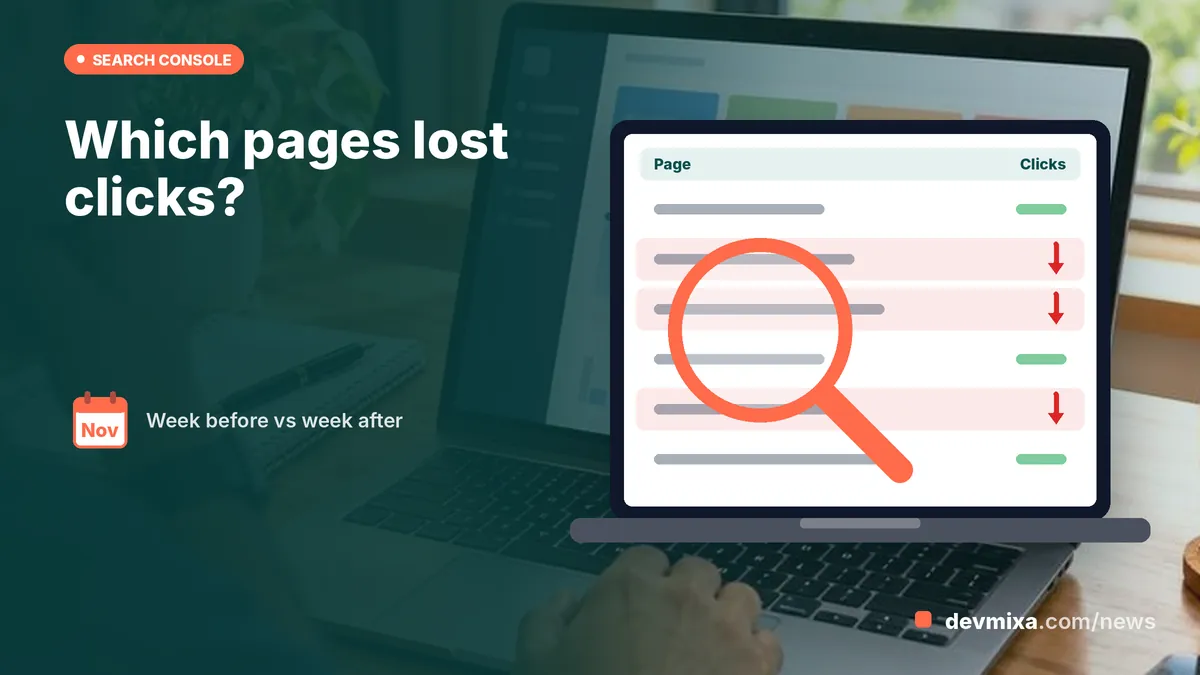
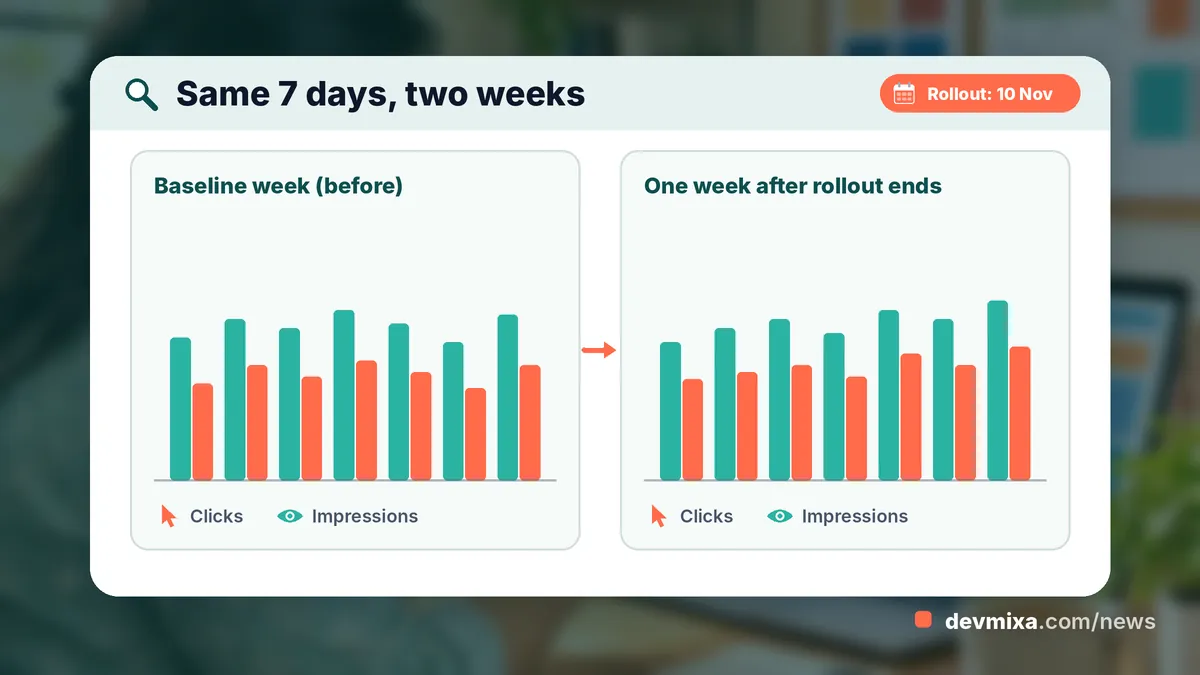
In the Performance report of Google Search Console, compare the week before the rollout began with a period after completion. In practice, that means roughly 3 to 9 November 2026 against a matching seven days once the update has settled. Keep the same weekdays on both sides.
Then split the data. Google suggests looking at Web, Images, Video and News search types separately, and you should also sort by page and by query. Usually a drop clusters in a few pages, like water collecting in one dip of a terrace roof rather than across the whole surface.
Finally, judge the size. Google says small position changes do not need drastic action, and it advises against changing content that already performs well. A slide from position 3 to position 5 on one query is a nudge. A sustained loss across your main service pages is a signal for the deeper checks below.
Check 3: Audit your Google Business Profile after the core update
Treat your Google Business Profile after core update news as a separate job, because local map results and website rankings are judged in related but different ways. Google's Business Profile help page ranks local results chiefly on how relevant, how close and how prominent a business is. Its announcement for this update did not single out local results.
Still, the core update impact on local rankings can travel through your website. Prominence means how well known a business is, partly judged from links and reviews, and a website that slips in search may quietly dent that picture. So open your profile on Google Maps and check it the way a new customer would.
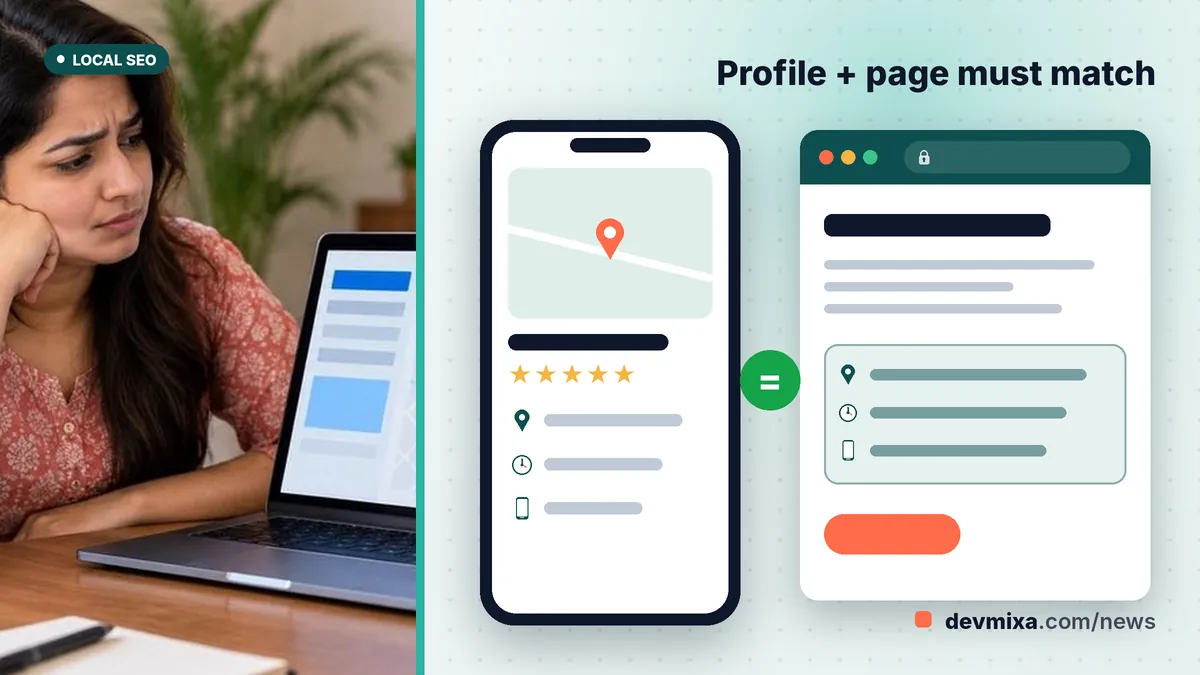
- Is the business name, address and phone number identical on the profile, your website footer and directories? This NAP consistency is basic hygiene.
- Are regular hours and special hours correct for the wedding and festival weeks ahead?
- Does the primary category describe what you actually sell, rather than a wishful broader term?
- Do recent photos show the real shop, staff and products?
- Have you replied to recent customer reviews, both good and bad?
Google says businesses with complete and accurate information "are more likely to show up in local search results", and that more reviews and positive ratings can help local ranking. If you dropped out of the local pack, start here before rewriting a single page.
Check 4: Local landing pages for Indian small businesses that help, not trick
Good local landing pages for Indian small businesses answer a real visitor's question about one place, and weak ones only swap the city name. A plumber who serves Bhopal, Sehore and Vidisha may want three pages. That is fine if each page says something true and specific about that area.
Try this test. Cover the city name with your thumb and read the page. If it could describe any town in India, it is closer to doorway pages, which Google treats as spam, than to helpful content. A real local page carries the details only you know: the areas you visit, the time you take to reach them, a photo from a job there and the landmark near your branch.
Should you build a page for every area you serve?
Only where you genuinely serve it and can write something different. For example, a single-branch tuition centre does not need 40 suburb pages. One strong page with a clear address, directions and a map embed will usually do more work than a crowd of thin clones.
Add LocalBusiness schema as structured data on the page that matches your Business Profile, with the same name, address and phone. Make sure each local page has a self-referencing canonical tag and appears in your XML sitemap. Thin content stitched from templates is a signboard repainted forty times with different street names.
Check 5: PHP website SEO after core update, from server to sitemap
Any review of PHP website SEO after core update news starts with one boring question: is the site still being looked after? Plenty of Indian small business sites run on custom PHP or older WordPress builds hosted on cPanel hosting plans that nobody has opened in years.
An outdated PHP version is not a ranking factor that Google names. The risk is indirect. Old code breaks after host upgrades, slows pages, throws errors to Googlebot and leaves security holes that hackers fill with spam pages.
Which PHP versions are supported right now?
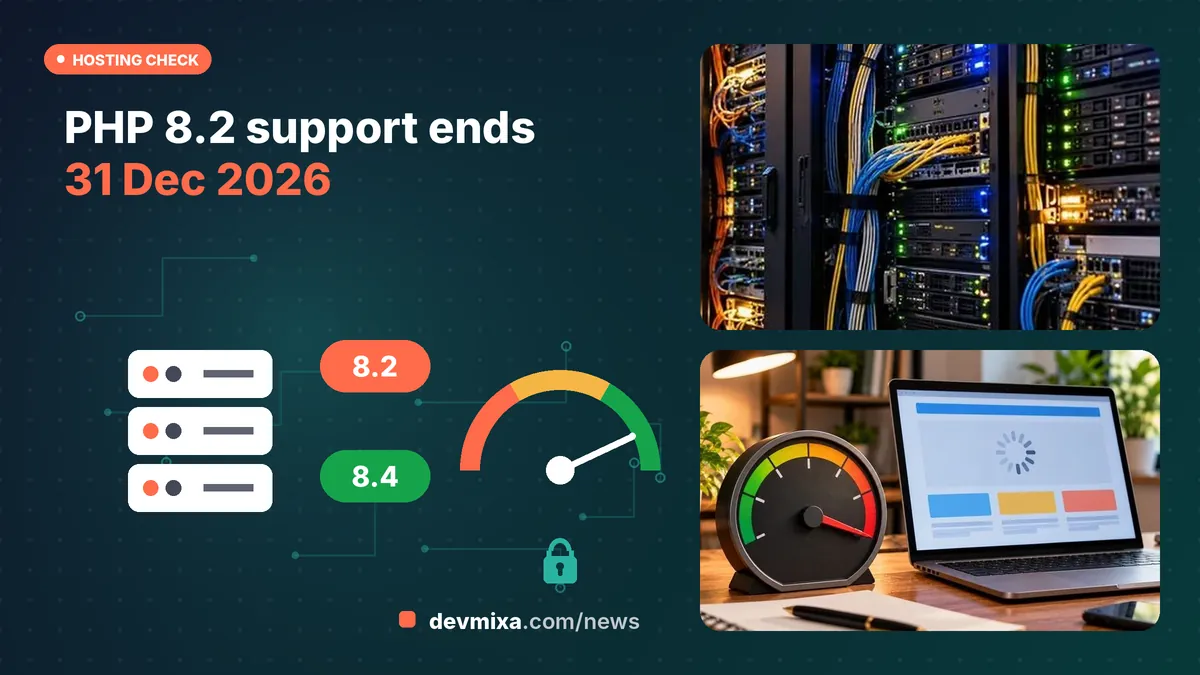
According to the official php.net supported versions page, security support ends on 31 December 2026 for PHP 8.2, 31 December 2027 for 8.3, 31 December 2028 for 8.4 and 31 December 2029 for 8.5. PHP 8.1 and older are no longer supported. If your host panel still shows 7.4 or 8.1, plan an upgrade with your developer, and test it on a copy first.
While you are in the server room, so to speak, open Search Console. Look at the Pages report for sudden "Not found" or "Server error" spikes, check the Security issues report and confirm that your sitemap was read recently. Under mobile-first indexing, Google mainly crawls the mobile version, so confirm that menus, prices and contact details appear on mobile too. If routine upkeep keeps slipping, a website maintenance and support plan is one way to keep it from piling up.
Check 6: Core web vitals for small business websites on budget phones
Core web vitals for small business websites should be judged on the phones your customers carry, not on the owner's new laptop. Google's documentation gives three "good" targets: Largest Contentful Paint within 2.5 seconds, Interaction to Next Paint under 200 milliseconds, and Cumulative Layout Shift under 0.1.
Google is careful with its wording here. It says these metrics, along with other page experience aspects, align with what its core ranking systems "seek to reward". That is not a promise that a fast site jumps to the top. A slow page is more like a shop with a stuck shutter: the goods may be excellent, but people walk to the next door.
Test your home page and two key service pages in PageSpeed Insights, reading the field data from real visitors first. Common fixes on Indian SMB sites are dull but effective:
- Compress oversized banner images and serve them in WebP.
- Remove sliders and chat widgets that load heavy scripts on every page.
- Reserve space for images and ads so the layout does not jump.
- Turn on caching and, if your host offers it, a CDN.
Speed will not rescue a page that dropped in a core update on its own. Treat it as one part of the job, alongside content that answers the visitor.
Check 7: People-first content and E-E-A-T for a neighbourhood business
The seventh check asks whether your pages are written for customers or for search engines. Google publishes a set of self-assessment questions for this, and its core update guide suggests asking trusted people who are not connected to your business to read your site with those questions in hand.
E-E-A-T stands for experience, expertise, authoritativeness and trust. It sounds academic, but for a local shop it is practical.
Who runs the business? How long have you been doing this work? Is there a real address, a GST-registered name where relevant, clear prices or price ranges, and genuine photos? A CA firm's page written by a qualified partner, with a name and credentials, shows more trust than an unsigned page copied from three competitors.
Should you delete old blog posts?
Not in a hurry. Google calls deleting content a last resort, for material that cannot be improved. Old posts that still answer real questions can be updated instead. For example, a hypothetical 2019 post on "GST rates for sweets" would be better refreshed with current facts and a date than removed.
Read your top ten pages aloud. Where a paragraph says nothing new, cut it. Where a customer would ask "but how much, how long, which area?", add the answer.
Hands off during the rollout: what to freeze and how long recovery takes
The safest move during an active rollout is to freeze big changes. If you redesign the site, change URLs or rewrite every page now, you will never know whether the update or your edits moved the numbers. Fix genuine errors, such as a broken contact form, but park the redesign.
How long does Google core update rollout take? Google gave up to two weeks for this one. Search Engine Roundtable counts a median of 14 days across 23 core updates, while the March 2024 update ran for 45 days. This year the March update took about 12 days and the May update just under 12 days, according to PPC Land.
When can you expect recovery?
Google is frank that recovery is not guaranteed. Its guidance allows that some improvements show up within days. Others can take months, because its systems need time to see that a site keeps publishing helpful pages over the long run. If nothing changes after a few months, Google suggests waiting for the next core update, and it also runs smaller, unannounced core updates in between.
Recovery is closer to a monsoon crop than a microwave meal: you prepare the soil now, and the harvest arrives on its own schedule.
Your November 2026 core update checklist for small business sites, in order
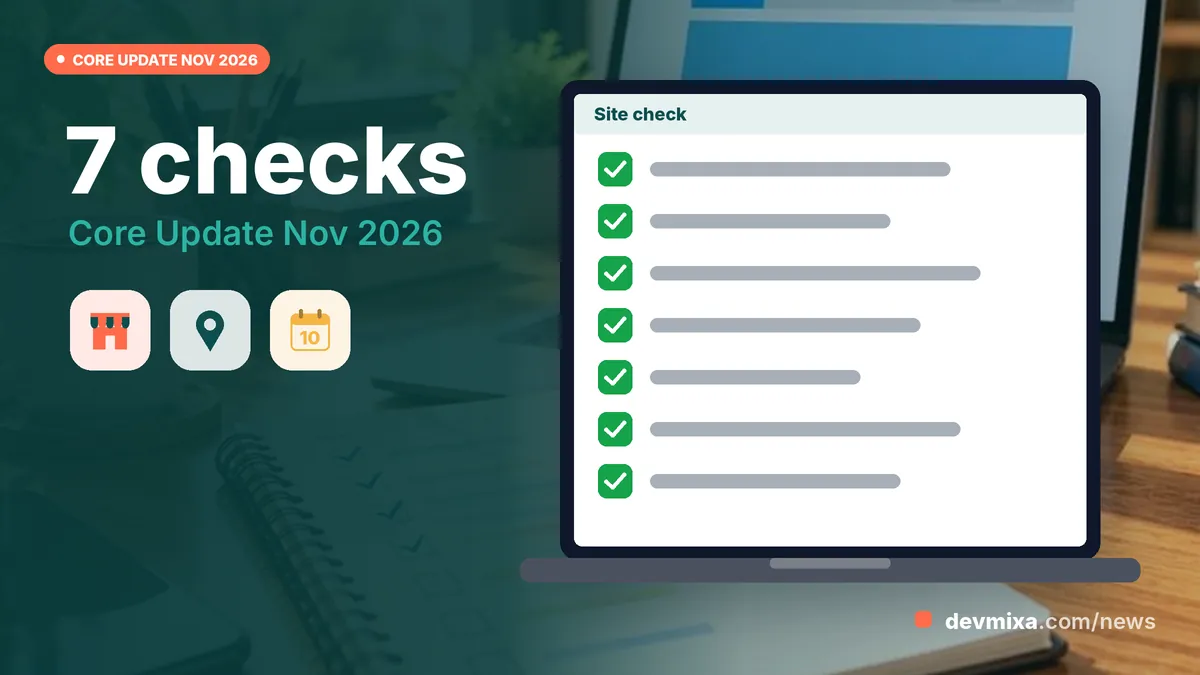
The full November 2026 core update checklist for small business owners fits in one list you can print and tick.
- Bookmark the Search Status Dashboard entry and note the date Google marks the update complete.
- Today, export a snapshot of Search Console clicks, impressions and top pages for 3 to 9 November 2026.
- Rule out site errors, tracking gaps and seasonal demand using branded queries and Google Analytics 4.
- Audit your Business Profile: name, address, phone, hours, category, photos and review replies.
- Read each local page with the city name covered, and rewrite or merge the ones that say nothing specific.
- Check your PHP version, the Pages report, the sitemap and the Security issues report.
- Test the home page and two service pages in PageSpeed Insights on mobile field data.
- Review your top ten pages against Google's self-assessment questions with an outside reader.
- One full week after completion, compare a matching seven-day period with the pre-update week.
- Only then decide what to rewrite, and change pages in small batches so you can measure the effect.
Most owners can run these checks alone; for a second pair of eyes on the data, an independent SEO review can help. For more updates on search and site building, browse our web development news. Search rules and support dates change, so confirm details on the official Google and php.net pages before acting.
Frequently asked questions
Is a Google core update a penalty?
No. Google describes core updates as broad changes to its ranking systems that do not target specific sites or pages. A drop usually means other pages now look more helpful for a query. Manual actions are different and appear as a message in the Manual actions report of Search Console.
Will Google tell me if my site was affected by the core update?
No. Google does not send site-level notices for core updates. You have to judge the effect yourself in Search Console. Compare the week before 10 November with a matching week that starts at least seven days after Google marks the rollout complete on its dashboard.
Can I pay Google for a better local ranking?
No. Google's Business Profile help page states plainly that there is no way to request or pay for a better local ranking.
Do customer reviews help local rankings after a core update?
Google says more reviews and positive ratings can help a business's local ranking. Ask genuine customers for honest reviews and reply to them, but never buy or swap reviews. Fake reviews break Google's policies and can lead to removal or restrictions on your profile.
Does the core update affect Discover and AI Overviews?
Search Engine Roundtable reports that core updates can also affect Google Discover and features such as featured snippets. Google's November announcement did not single out AI Overviews, so treat any claims about a specific AI Overviews change as unconfirmed until Google says more.
How many core updates has Google released in 2026?
Google has released three so far. The March 2026 core update ran from 27 March to 8 April, and the May 2026 update from 21 May to 2 June. The November 2026 update began on 10 November, according to Google's dashboard and Search Engine Roundtable's update history.
Should I hire an SEO agency after a traffic drop?
Not straight away. Wait until the rollout finishes, run the seven checks and compare data properly. If the drop is large and lasts, an experienced, independent reviewer can help. Avoid anyone who promises a guaranteed ranking or a recovery date, because Google itself offers no guarantee.
Do I need to rebuild my website after a core update?
Usually not. Google advises meaningful improvements to content and warns against quick fixes. A rebuild makes sense only when the site is technically broken, unmaintained or impossible to update. Even then, keep URLs stable and redirect old pages properly.
Will the core update affect my Black Friday sales?
It might, if your shop relies on organic search. Black Friday falls on 27 November 2026, close to the end of the expected rollout window. Shops that depend on Google traffic may want a backup plan, such as WhatsApp broadcasts to existing customers or a small paid campaign.
How often should a small business check Search Console?
A quick look once a week is enough for most small sites, with a deeper monthly review of top pages and queries. Turn on email alerts so Google can tell you about indexing errors, security issues or manual actions without you having to log in every day.
Planning a website, web app or SEO upgrade?
Tell us what you need. We reply within one working day with a clear plan and price.