In this story11 sections
- Does the DPDP Act cover a five-page business website?
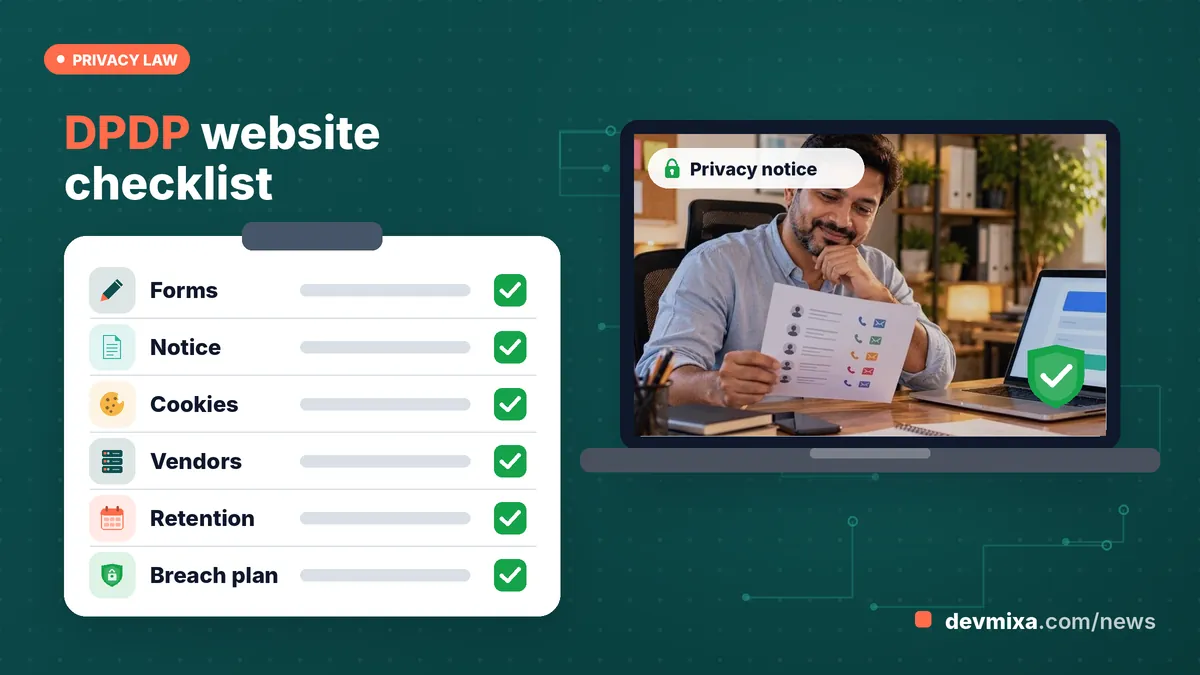
- How to audit website for DPDP compliance: draw the data map first
- Contact form consent under DPDP rules: tick boxes, fields and young visitors
- What a DPDP compliant privacy policy for website visitors must spell out
- Grievance officer details on website DPDP pages: the contact box and the 90-day clock
- Cookie consent banner as per DPDP Act: what the text says and what it leaves open
- DPDP compliance for WordPress website owners: plugins, hosts and the WhatsApp button
- Withdrawal, deletion and a data retention policy your staff will follow
- Reasonable security safeguards and a breach plan written before you need it
- The DPDP Act checklist for small business website owners, page by page
- Frequently asked questions
Open your business website in a private browser window and count how often it asks a stranger for a name, a mobile number or an email. Most shop, clinic and coaching sites ask three or four times, and every one of those boxes falls under India's data protection law. This DPDP Act checklist for small business website owners goes through each form, cookie, plugin and vendor. The aim is a site that meets the duties applying in full from 13 May 2027.
| Point | Details |
|---|---|
| What this guide covers | A page-by-page website audit under the Digital Personal Data Protection Act 2023 and the DPDP Rules 2025: forms, privacy notice, cookies, vendors, retention, security and breach plan |
| Who it is for | Owners of small business, clinic, coaching, shop and service websites, plus the freelancers and agencies who build them |
| Time needed | About half a day for the audit on a typical 5 to 20 page site; fixes take longer if plugins or vendors must change |
| Key dates | Rules notified 13 November 2025 (G.S.R. 846(E)); consent, notice, security, breach and retention duties apply from 13 May 2027 (as of November 2026) |
| Official source | MeitY and PIB material on the Act and the Rules |
| What to do | Map your data, fix forms and notices, publish a contact for privacy questions, sign vendor contracts, write a retention and breach plan |
Does the DPDP Act cover a five-page business website?
Yes, in nearly every case. Your site may collect a name, phone number, email address, delivery address, uploaded CV or chat message. If any such detail identifies a person and exists in digital form, the Digital Personal Data Protection Act 2023 applies. In the law's vocabulary, you are the Data Fiduciary who decides why and how the data is used, and the visitor is the Data Principal.
There is no turnover or headcount threshold. DPDP website compliance for MSME in India rests on the same core duties a large company faces. Only the extra layer for a Significant Data Fiduciary scales with size. Data a person made public themselves, and purely domestic use, fall outside the Act, but a business enquiry is neither.
A site whose only data point is a contact form is still covered. Section 7(a) treats data a person voluntarily hands over for a specified purpose as a legitimate use, so replying may not need a consent box. Security, erasure and contact duties still apply, and adding that person to a mailing list needs consent.
On timing, the Rules appeared in the Gazette on 13 November 2025, and the DPDP Rules 2025 deadline for websites is 13 May 2027, eighteen months later. Check for any official amendment before relying on it.
How to audit website for DPDP compliance: draw the data map first
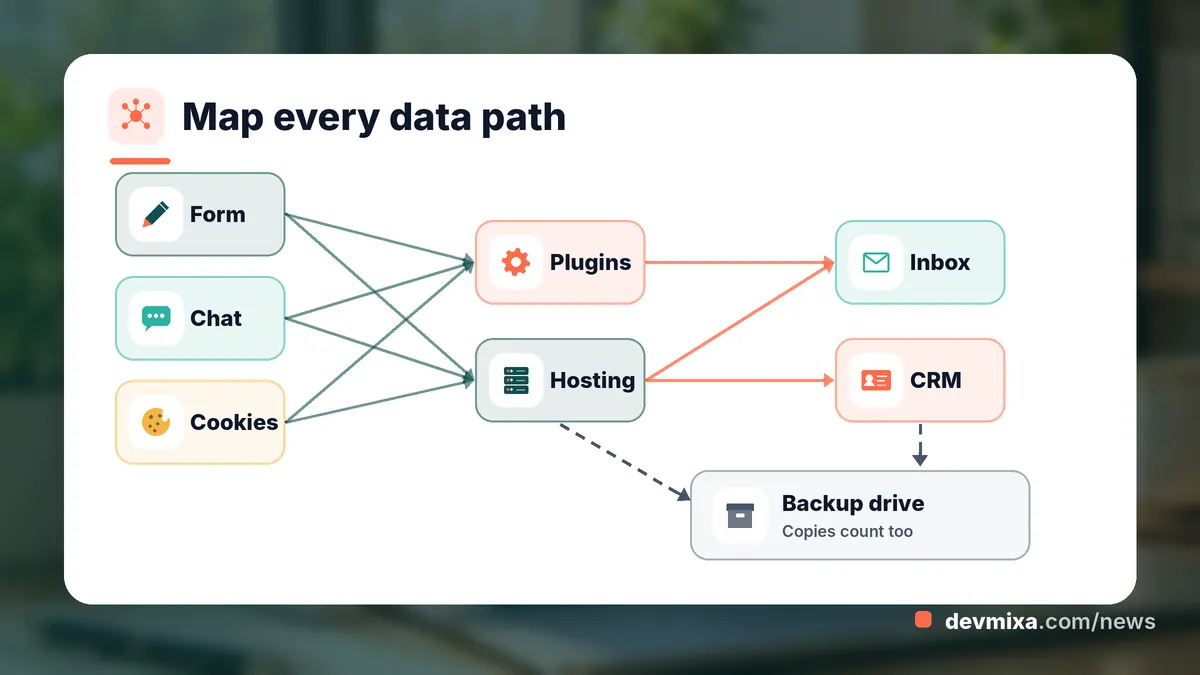
Start with a list of every place the site touches personal data, because no fix lands on a problem you have not found. Think of it as a stock register for information: one spreadsheet row per collection point.
- Forms: contact, quote request, appointment booking, job application with CV upload, newsletter sign-up and checkout.
- Embeds and scripts: chat widgets, maps, video players, Google Analytics, Meta Pixel and any advertising or heatmap tag.
- Back office: the inbox that receives form emails, the CRM or spreadsheet where leads end up, database tables where plugins store entries, and backups in the hosting panel.
- People: staff, freelancers and agencies with admin logins.
For each row, write which fields are collected, why, where they are stored, who can see them and how long they stay. The browser helps: right-click a page, choose Inspect, and the Network tab lists every third-party domain it calls, while the Application or Storage tab shows cookies.
For example, a hypothetical Bhopal coaching institute might find an admission form asking for an Aadhaar number nobody uses, and four former interns who still hold passwords. None of that shows on the homepage. All of it belongs on a DPDP Act checklist for small business website reviews.
Contact form consent under DPDP rules: tick boxes, fields and young visitors
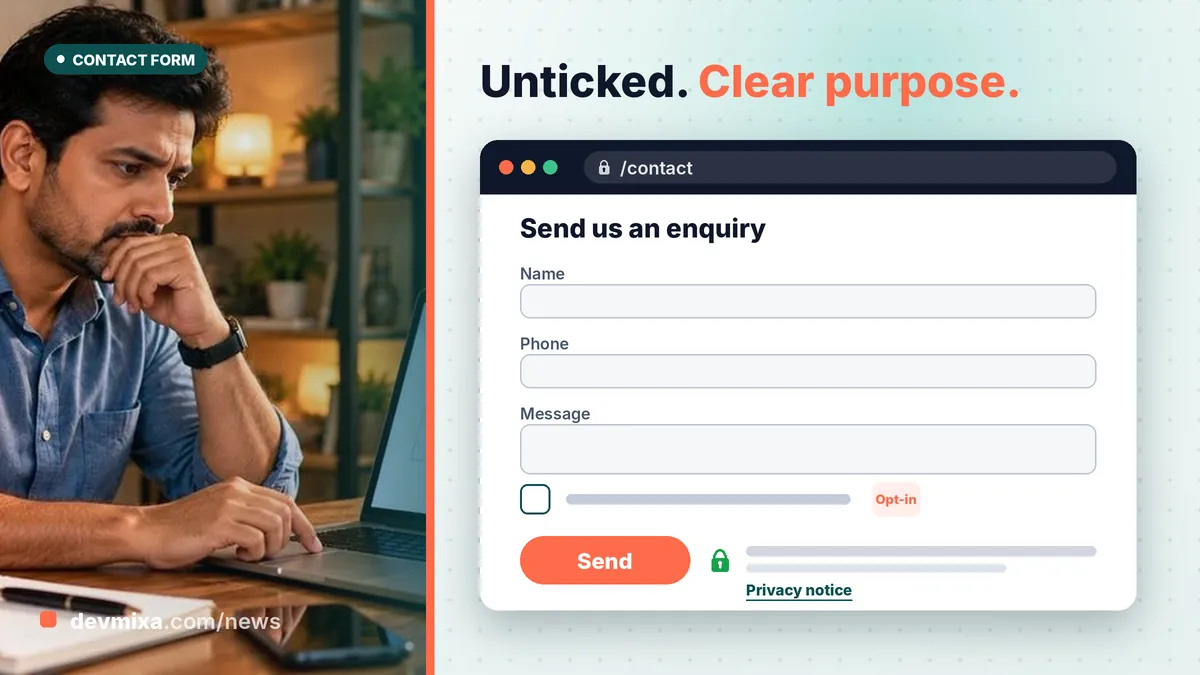
A form passes when it asks only for what its purpose needs, explains that purpose beside the submit button and never assumes agreement. Section 6(1) of the Act says valid consent has five qualities (free, specific, informed, unconditional, unambiguous) and needs a clear affirmative action. That last phrase settles one common question: a pre-ticked checkbox does not count, because the visitor did nothing.
Three fixes cover most sites. Apply data minimisation: if a date of birth adds nothing to a callback request, delete the field. Respect purpose limitation with separate, unticked boxes for separate uses, such as offers on WhatsApp or email.
Never make marketing consent a condition of sending the form. A one-line note under the button can name the purpose and link to the privacy notice.
If children may fill in the form
Under the Act a child is anyone below 18, which includes most coaching, school and gaming audiences. Processing children's personal data needs verifiable parental consent, and Rule 10 sets out how to confirm that the parent is an adult. A business can rely on identity and age details or a token from an authorised service such as DigiLocker.
Tracking children, monitoring their behaviour or aiming ads at them is off limits under the Act. The Rules exempt some cases, such as healthcare, education and real-time safety.
What a DPDP compliant privacy policy for website visitors must spell out
Rule 3 asks for a privacy notice that makes sense on its own and uses clear, plain language. A DPDP compliant privacy policy for website visitors should cover each item the rule lists, which in practice means:
- an itemised description of the personal data you collect, field by field, not "information you may provide";
- the specific purpose for each item and the goods or services it supports;
- a link or method to withdraw consent, as easy as the way consent was given;
- how to exercise rights such as access, correction and erasure;
- how to complain to the Data Protection Board of India.
The Act also lets a person choose to read the notice in English or in any language listed in the Eighth Schedule of the Constitution.
Old pages deserve a hard look. Many Indian privacy policies date from the IT Act 2000 rules. Others were copied from a European template full of GDPR terms such as "legitimate interests", a basis the DPDP Act does not recognise. Write yours from your data map, and back the footer link with a short notice line at each form.
Grievance officer details on website DPDP pages: the contact box and the 90-day clock
Rule 9 requires every Data Fiduciary to publish a business contact prominently on its website or app. That contact is a Data Protection Officer or a person who can answer questions about personal data. Listing grievance officer details on website DPDP pages is therefore mandatory, even for a two-person firm. The same contact must appear in every reply to a rights request.
A role-based address such as privacy@yourdomain survives staff changes better than a personal Gmail ID. Put it on the privacy notice, the contact page and the footer.
Rule 14 adds a clock. Businesses must publish how people can make requests, and grievance redressal must happen within a reasonable period not exceeding 90 days. Assign one owner, because ninety days vanish quickly in a shared inbox.
Do you need a formal Data Protection Officer? Only if the government notifies you as a Significant Data Fiduciary, which brings Section 10 duties: an India-based officer, an independent data auditor and periodic impact assessments. The Centre picks such businesses on factors such as the volume and sensitivity of their data. A local bakery or dental clinic is unlikely to receive that notice.
Cookie consent banner as per DPDP Act: what the text says and what it leaves open
The Act and the Rules contain no cookie-specific rule, so no clause orders a banner by name. Yet a cookie consent banner as per DPDP Act principles is the most practical way to meet Section 6 when tracking tools collect personal data on a consent basis. What follows is our reading of the law, not settled guidance, so confirm it with a professional for your case.
Split your cookies into two piles. Strictly necessary ones, such as a session login, a shopping cart or a security token, make the site work, and many practitioners treat them as outside the consent question. Analytics and advertising tags are different, because Google Analytics and Meta Pixel can tie browsing behaviour to a device or an ad profile. The safer course is to load them only after the visitor clicks Accept.
How does this differ from Europe? There, the cookie rule comes from a separate ePrivacy law, and the GDPR allows a "legitimate interests" basis. The DPDP Act offers only consent or a short list of legitimate uses.
A fair cookie banner shows Accept and Reject with equal weight, keeps optional categories unticked and leaves a footer link to change the choice. A banner that hides Reject behind three clicks is a turnstile that spins only one way.
DPDP compliance for WordPress website owners: plugins, hosts and the WhatsApp button
A WordPress site rarely breaks the rules through its core software. The risk sits in the plugins, form builders and embeds added over the years.
Good DPDP compliance for WordPress website owners begins in the Plugins screen. Deactivate and delete anything unused, then check what the rest store. Many form plugins save every entry in the database as well as emailing it, which doubles the copies you must protect and later delete.
The Tools menu in WordPress includes Export Personal Data and Erase Personal Data (as of November 2026). They help answer access and deletion requests for data held by the core and by compatible plugins.
Next, list your vendors. A host, form service, email tool, CRM or payment gateway handling data on your behalf is a Data Processor. Section 8(2) allows one only under a valid contract, and you stay responsible for its conduct. Keep a copy of each vendor's data processing terms.
The WhatsApp chat widget needs its own line. A plain click-to-chat link only opens WhatsApp, but the conversation lands in your business account, and the names, numbers and messages in it are personal data you hold. Some chat plugins also load extra scripts.
Withdrawal, deletion and a data retention policy your staff will follow
Leaving must be as easy as joining: Section 6(4) says the ease of withdrawal of consent should be comparable to the ease with which it was given. If one tick signed someone up, one click should take them off. Put an unsubscribe link in every marketing email, a "Privacy choices" link in the footer and a clear email or form for any data erasure request.
Once consent goes, or the purpose is served, Section 8(7) says the data must be erased unless another law requires you to keep it.
How long can you keep the rest? The Third Schedule sets a fixed three-year limit and a 48-hour warning before erasure, but only for large classes. These are e-commerce entities and social media intermediaries with at least 2 crore registered users, and online gaming intermediaries with at least 50 lakh. A small site sets its own periods, with one floor. Rule 8 asks every Data Fiduciary to keep personal data, traffic data and related logs for at least one year from processing, for purposes listed in the Rules.
Write a one-page data retention policy with one line per data type. Then set a recurring reminder so the deleting happens. A policy nobody enforces is a dusty file in a cupboard.
Reasonable security safeguards and a breach plan written before you need it
Rule 6 spells out what reasonable security safeguards look like: encryption, masking or tokenisation where suitable, access controls, logs and monitoring, backups, and security terms in contracts with processors. Logs must be kept for one year unless another law says otherwise.
For a small site, that starts with a valid SSL certificate so every page loads over HTTPS, plus prompt updates. Give each person a personal login with two-factor authentication, and keep encrypted off-server backups you have restored at least once.
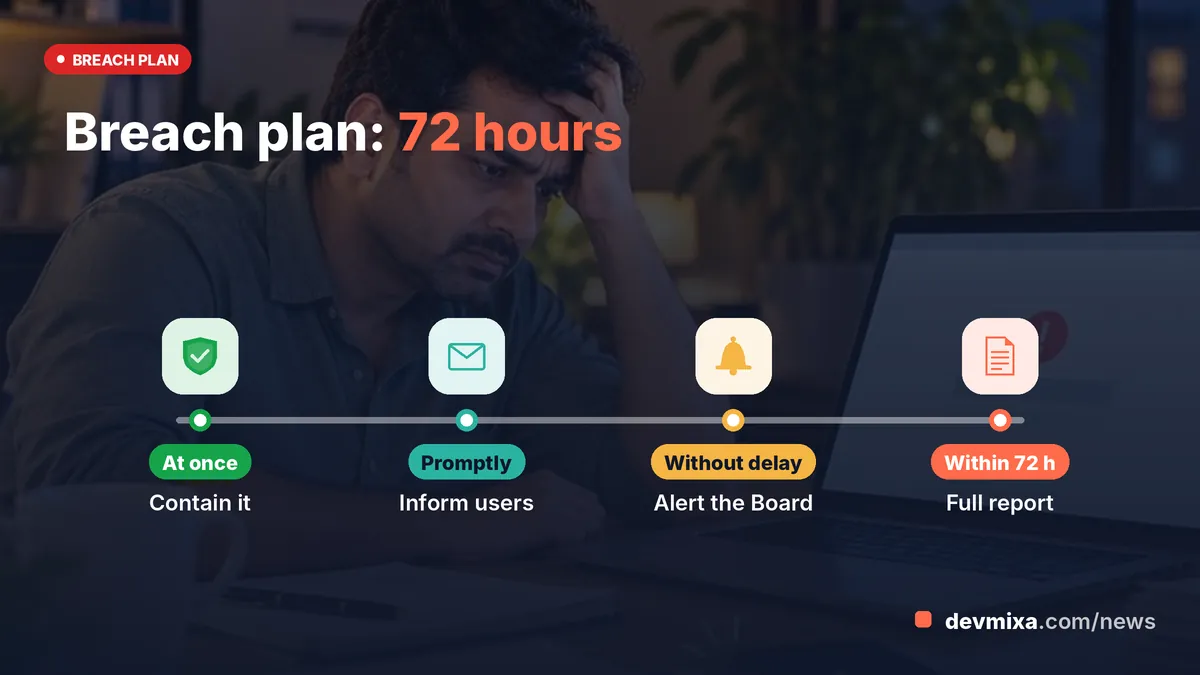
If a personal data breach happens, Rule 7 requires you to alert each affected Data Principal promptly and in plain language. The message covers the incident, its probable impact, your response and a contact. The Board must be informed without delay, with a detailed breach intimation within 72 hours of becoming aware of it. Separately, CERT-In directions from April 2022 ask for certain cyber incidents to be reported within six hours.
The Act allows a penalty up to Rs 250 crore where safeguards are missing and up to Rs 200 crore where a breach goes unreported. This is general information, so confirm your duties on the official pages or with a lawyer or security professional.
The DPDP Act checklist for small business website owners, page by page
Use this DPDP Act checklist for small business website upkeep as a working sheet. Each tick should match a change you can show.
- Build the data map: every form, script, inbox, CRM, backup and login.
- Remove fields, plugins and tags that serve no current purpose.
- Replace any pre-ticked checkbox with an unticked, purpose-specific one.
- Add a one-line purpose note and notice link under each form.
- Rewrite the privacy notice from your data map, with a Hindi version if your customers prefer it.
- Publish a privacy contact on the notice, contact page and footer, and name an owner for the 90-day reply window.
- Load analytics and ad tags only after consent, with an equal Reject button.
- Collect data processing terms from your host, form tool, CRM and payment gateway.
- Add unsubscribe, withdrawal and deletion routes that take a single step.
- Write the retention policy and set calendar reminders to delete.
- Turn on HTTPS, updates, two-factor logins and tested backups.
- Write a one-page breach plan with phone numbers and the 72-hour step.
If the list exposes larger rebuild work, a website development team can rework forms and consent flows, while ongoing maintenance and support keeps plugins, backups and logs in order. For the official explanation of each duty, read the government's explainer on the DPDP Rules.
Frequently asked questions
Are web hosts and form tools Data Processors under DPDP?
Usually, yes. A host, form service, CRM, email platform or payment gateway that handles personal data on your behalf acts as a Data Processor. You may use one only under a valid contract, and you, as the Data Fiduciary, remain responsible for how it treats your customers' data.
Is the website owner or the web developer responsible for DPDP compliance?
The business that decides why and how customer data is collected carries the legal responsibility, which normally means the website owner. A developer or agency may act as a processor, and your contract with them should cover security and deletion.
What is a consent manager under the DPDP Rules?
A consent manager is a company registered with the Data Protection Board that offers people one platform to give, review and withdraw consent across services. Rule 4 asks for an Indian company whose net worth is ₹2 crore or more. Small websites need not use one.
What penalties can follow DPDP non-compliance?
The Act's schedule caps fines at ₹250 crore for weak security safeguards and ₹200 crore for unreported breaches or children's data lapses. Failures by a Significant Data Fiduciary can cost up to ₹150 crore, and other violations up to ₹50 crore. The Board fixes the actual amount case by case.
Do startups or small firms get any DPDP exemption?
Not automatically. Section 17(3) lets the Central Government notify certain businesses, including startups, as exempt from some provisions, such as notice and erasure duties, based on the volume and nature of data. Check for any such notification before relying on it. Until then, treat every duty in this checklist as applying to you.
How can a business in Bhopal find DPDP gaps without hiring a lawyer?
Start with the data map: list every form, cookie, plugin, inbox and vendor, then compare each against this DPDP Act checklist for small business website owners. Browser developer tools show third-party scripts, and the WordPress Plugins screen shows what is installed. Consult a lawyer for children's services or health records.
Where do Indian business websites usually slip up on DPDP?
Pre-ticked marketing boxes and analytics that load before any choice top the list. Next come privacy notices copied from another site, no named privacy contact and enquiry forms that ask for needless details. Old plugins storing years of form entries and former staff with live admin logins are common too.
Does a WordPress or Shopify site need extra plugins to be DPDP compliant?
Not necessarily. A consent banner tool helps if you run analytics or ad tags, but compliance comes from what the site collects and how you handle it, not from a plugin count. On Shopify, review the apps you have installed and the privacy settings in the admin with the same checklist.
How should consent records be stored as proof?
Keep a simple log for each consent: the date and time, the form or banner used, the exact notice text or version shown, the choices made and any later withdrawal. If the Board or a customer asks, you should be able to show when and how a person agreed.
What should a business do after finishing the DPDP website checklist?
Keep the work alive. Review the data map whenever you add a form, plugin or vendor, and run a short audit every six months. Recheck the official MeitY and Board pages for amendments, especially around the 13 May 2027 start date.
Planning a website, web app or SEO upgrade?
Tell us what you need. We reply within one working day with a clear plan and price.