In this story11 sections
- Signs that a fake website using my brand name is live
- Build an evidence file before the clone moves
- How to find who owns a fake domain with WHOIS and RDAP
- How to report phishing website to Google Safe Browsing
- Report fake website to CERT-In India and the cybercrime portal
- Send abuse complaint to domain registrar and host
- Google DMCA request for copied website content and fake ads
- Trademark action against fake website in India and what courts have ordered
- Warn customers about fake website of business and watch for lookalikes
- How to take down a cloned website fast: a 48-hour checklist
- Frequently asked questions
Say a customer in Indore calls to ask why your "50 percent off" sale page wanted her UPI PIN, and you have never run that sale. Somewhere online there is a fake website using my brand name, you think, with your logo, your photos and a domain one letter away from yours. This guide, written for Indian business owners, walks through every reporting route that works as of November 2026: Google, CERT-In, the cybercrime portal, registrars, hosts and the courts.
| Item | Details |
|---|---|
| What | A cloned website or lookalike domain that copies your brand to cheat buyers or steal logins |
| Who it affects | Shops, D2C brands, clinics, coaching centres, dealers and any business with a known name online |
| Key routes | Google Safe Browsing, CERT-In (incident@cert-in.org.in), cybercrime.gov.in, 1930 helpline, registrar and host abuse desks, Google Legal Help |
| Key dates | Delhi High Court brand-impersonation judgment, December 2025; registrars' challenge before a larger bench, listed for 16 July 2026 (status unclear) |
| Official source | Google Safe Browsing phishing report form |
| What to do | Save evidence, report to Google and the portal, write to the registrar and host, then warn customers |
This is general information, not legal advice. Confirm each step on the official page and consult a lawyer for court action or large losses.
Signs that a fake website using my brand name is live
The first sign is rarely a security alert; it is usually a confused customer. People call about orders you never received, discounts you never offered, or a "dealer registration fee" you never asked for. Other clues arrive quietly: Google Ads showing your name on a domain you do not own, or a payment screenshot naming a bank account you have never seen.
This is brand impersonation, and the logic behind it is cold and simple. Your name already carries trust, so a scammer borrows it the way a pickpocket borrows a crowd. A cloned website lifts your layout, product photos and contact page, then swaps in a new phone number, a WhatsApp link and a payment QR code. Some are phishing kits that capture logins or card numbers; others sell goods that never ship.
The domain is the giveaway. Typosquatting uses a slip of the finger: an extra letter, a swapped vowel, a .in where you use .com, or a hyphen added between words. A lookalike domain may also add words such as "official", "store", "offer" or "dealership" to sound authentic. If you have searched for "fake website using my brand name" after one of these calls, start a fresh notebook.
Build an evidence file before the clone moves
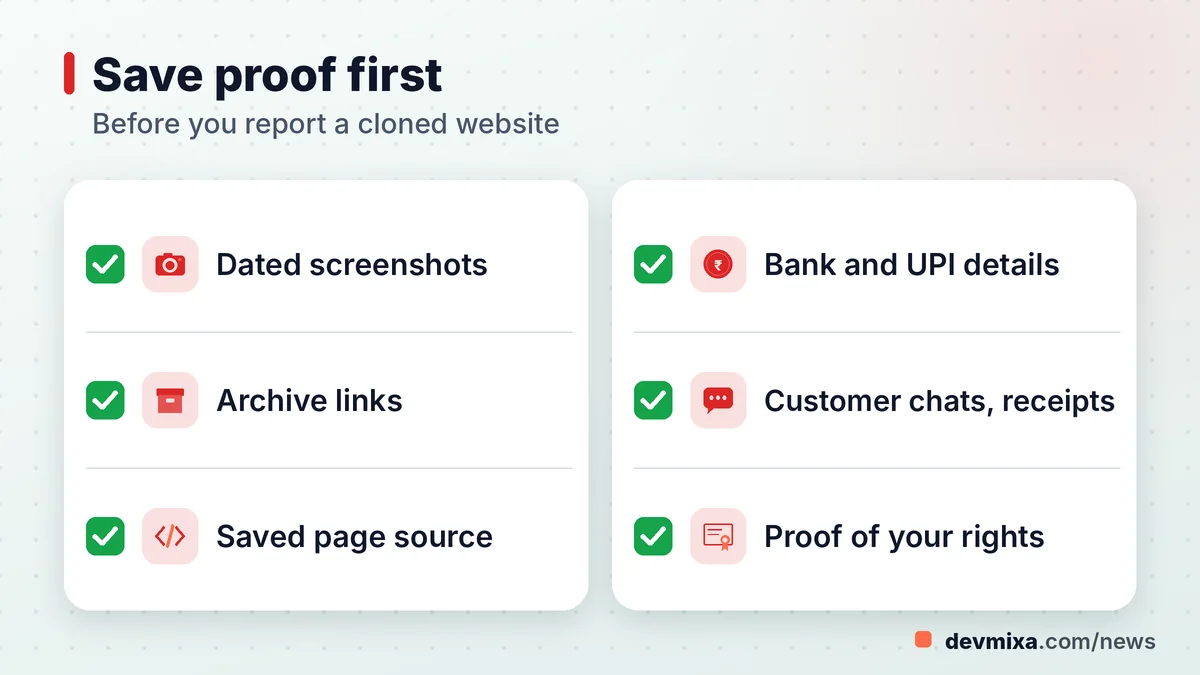
Collect proof first, because fake sites can vanish or change within hours and a complaint without evidence is a letter with no address. Treat screenshots as evidence and capture them with care: the full page, the address bar showing the URL, the date and time on your system clock, and every page that shows your logo, prices or payment details.
Then save copies that others can check. Submit the URL to a web archive such as the Internet Archive's Wayback Machine, which keeps a public, timestamped snapshot even if the scammer deletes the page. Save the page source (Ctrl+U in most browsers) too, because it may still contain your original image paths, which proves copying better than any argument.
Your evidence file should include:
- Every fake URL, including redirect links shared on WhatsApp or SMS
- Screenshots with visible URLs and timestamps
- Archive links and saved page source
- Bank account numbers, UPI IDs and phone numbers shown on the clone
- Customer complaints, chat screenshots and payment receipts (with consent)
- Proof of your own rights: trademark certificate if you have one, domain registration date, and dated copies of your original content
Keep a simple log of what you sent, to whom and when; it becomes your memory when ticket numbers pile up.
How to find who owns a fake domain with WHOIS and RDAP
You can find the registrar and hosting company of a fake domain in minutes, even when the owner's name stays hidden. It starts with a WHOIS lookup or its modern replacement, RDAP, the Registration Data Access Protocol that registries now use to publish domain records in a structured format. ICANN's lookup tool offers free searches.
The record will usually show the registrar's name, the creation date and a registrar abuse contact email. A domain created last week that copies a ten-year-old brand already tells a story. The owner's name is usually masked by a privacy service.
Next, find the host. Look up the domain's IP address with any DNS lookup tool, then run that IP through a WHOIS search to see which data centre or hosting company owns it. If the IP belongs to Cloudflare, the site sits behind a proxy and its real host is hidden; Cloudflare can pass your complaint on to that host.
One more clue comes from SSL certificate transparency. Every publicly trusted certificate is logged, and free search tools such as crt.sh list certificates issued for names containing your brand. That often reveals sister domains from the same scammer.
How to report phishing website to Google Safe Browsing
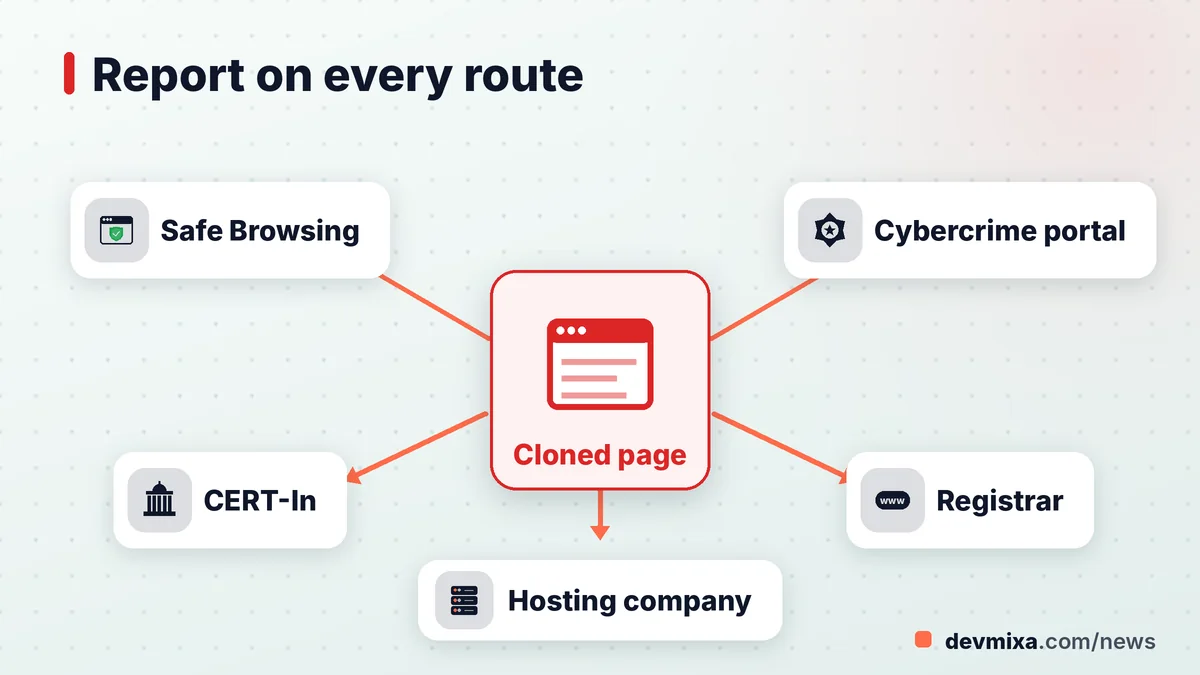
The fastest way to limit damage is to report the page to Google Safe Browsing, because a successful report can make Chrome show its red "Deceptive site ahead" warning. It takes two minutes: open Google's Report phishing page form, paste the exact URL, add a short note such as "imitates [your brand] website to collect payments", and submit.
Google's own search help page lists that form for pages that imitate another site to steal personal information. A separate Safe Browsing form exists for malware. Reporting is free, and you do not need to prove you own the brand.
Report each distinct URL, not only the home page, because clones often hide the payment page on a separate path. Google promises no timeline or reply, so recheck the URL in Chrome over the next few days. Once flagged, the clone loses much of its Chrome traffic to the warning screen.
Do not stop at Chrome. Microsoft SmartScreen protects Edge users and has its own unsafe-site report option inside the browser's help menu. Many Indian office computers run Edge by default, so a second report locks the other door of the same shop.
Report fake website to CERT-In India and the cybercrime portal
CERT-In, India's national cyber security agency, accepts phishing and website-impersonation incident reports by email at incident@cert-in.org.in. Send the URLs, screenshots, the date you found the site, and a short description. CERT-In handles the technical side; it is not the police and will not register a criminal case.
For a criminal complaint, use the National Cyber Crime Reporting Portal. A cybercrime.gov.in complaint for fake website cases normally goes under the "report other cyber crime" section, where you log in with a mobile number, describe the incident, upload evidence and receive an acknowledgement number to track progress.
The 1930 helpline is for money that is moving right now. If a customer has just paid the clone through UPI, card or bank transfer, they (the victim, not you) should call 1930 at once or file under the financial fraud section of the portal. Police and banks describe the first hour as the "golden hour", because a quick report gives the best chance of freezing funds before they are withdrawn.
So when customers have already paid, guide them; do not pay them blindly. Share the portal link and the 1930 number, ask them to keep transaction IDs, and record their complaint numbers in your own evidence log.
Send abuse complaint to domain registrar and host
Registrars and hosting companies can suspend a fraudulent domain or server, and they often act faster than any government body. Your next move is to complain to both, using the registrar abuse contact from the WHOIS or RDAP record and the hosting provider abuse address from the IP lookup.
A good complaint is short and factual. Use a clear subject line such as "Phishing site impersonating [brand] at [domain]". In the body, list each URL, explain what is copied and how it harms customers, attach screenshots and archive links, and state your connection to the brand. Ask for a specific action: suspension of the domain, removal of the content, and preservation of logs for police.
Many registrars and hosts also run a web form, which often returns a ticket number faster.
If the site sits behind Cloudflare, file a Cloudflare abuse report through its online abuse form and choose the phishing category. Cloudflare usually does not host the content itself, but it says it forwards complaints to the hosting provider and can show warning interstitials for confirmed phishing.
Google DMCA request for copied website content and fake ads
When a clone copies your text and photos, copyright law gives you a separate lever that works even without a trademark. A Google DMCA request for copied website content asks Google to remove the infringing URLs from its search results. File it through Google Legal Help or the reportcontent.google.com form, choose the copyright option, and list your original URLs next to the copied ones.
A DMCA takedown is a US legal process, but Google applies it worldwide to its own services, so Indian owners use it routinely. Be precise. A copyright notice is a formal legal statement, and false claims can create liability for you. Google may also publish a copy of the notice in the Lumen database.
Fake ads and social pages need their own reports. Google Ads has a trademark complaint and an ad report option for scam ads. Meta's Facebook and Instagram accept impersonation reports through their help centres, and WhatsApp lets users report and block a business number.
Keep in mind that removal from Google Search does not take the site off the internet. It only hides it from one doorway. Pair it with the registrar and host complaints above.
Trademark action against fake website in India and what courts have ordered
Yes, you can go to court, and Indian courts have become sharp with brand impersonators. In practice that usually means a civil suit under the Trade Marks Act 1999 for infringement, or for passing off if your mark is unregistered. The Copyright Act 1957 protects your site's original text and images, and the IT Act 2000 covers identity theft and cheating by personation using a computer resource, under Sections 66C and 66D.
The Delhi High Court has heard many such cases, with orders protecting names such as Dabur, Burger King and Zepto. In December 2025, Justice Prathiba M. Singh delivered a 248-page judgment in a batch of suits led by Dabur. According to NewsBytes, more than 1,100 fake websites were blocked. ThePrint reported that the court backed "dynamic" injunctions: when a fresh clone domain pops up, the brand owner files an affidavit to bring it under the existing blocking order rather than starting a new suit.
The same ruling told registrars to disclose registrant details within 72 hours, a duty GoDaddy has publicly warned could weaken domain privacy. GoDaddy and other registrars challenged it before a larger bench, Business Today reported on 3 July 2026, and we found no reported outcome as of 4 November. Treat those registrar duties as contested until the appeal is decided. Court action costs money and time, so it suits a clone that keeps coming back, the kind that has you searching "fake website using my brand name" every month, more than a one-off copy.
Warn customers about fake website of business and watch for lookalikes
A clear customer advisory protects buyers while takedowns grind on. The advisory needs three things: say it plainly, say it everywhere, and say how to check. Post a short notice on your home page, Google Business Profile, social pages and WhatsApp status, naming your only official domain, phone numbers and payment methods.
Avoid printing the fake URL as a clickable link; write it with spaces or as an image so nobody visits it by mistake. Add that you never ask for advance fees, OTPs or PINs.
Prevention comes next. Owners who search "how to monitor lookalike domains of my brand" are asking the right question, because watching costs less than fighting each clone. Set a Google Alert for your brand name, check certificate transparency logs on crt.sh once a week, and consider a domain monitoring service from a registrar or security vendor that flags new registrations with your name in them.
Should you buy common misspellings? Register a few obvious ones, such as the .in and .com versions and a single-letter typo, and point them at your real site. You cannot buy every variation, so treat this as a fence around the front gate, not a wall around the city.
How to take down a cloned website fast: a 48-hour checklist
Speed comes from running the reports in parallel, not one after another. Use this order on day one and day two:
- Save screenshots, archive links and page source for every fake URL.
- Run WHOIS or RDAP and an IP lookup to find the registrar, host and any Cloudflare proxy.
- Submit the Google Safe Browsing phishing report and a Microsoft SmartScreen report.
- Email CERT-In with URLs and evidence.
- File a complaint on the cybercrime portal and keep the acknowledgement number.
- Send abuse complaints to the registrar, host and Cloudflare with the same evidence pack.
- File a copyright request with Google for copied pages and report fake ads or social profiles.
- Publish your customer advisory and brief your support staff.
How long do takedowns take? There is no fixed clock. Browser warnings and host suspensions sometimes arrive within a day or two; registrar and court routes can take weeks. Follow up politely every few working days.
If the clone returns on a new domain, as many do, reuse your evidence pack, cite the earlier ticket numbers, and add the new domain to every report. Repeat clones are the pattern a lawyer needs for a dynamic injunction. If your own site needs hardening or regular checks, a website maintenance and support plan can include monitoring; for related scams, browse the Devmixa cybersecurity desk.
Frequently asked questions
Is copying someone's website illegal in India?
Copying original text, photos and design can infringe copyright under the Copyright Act 1957, and using a brand name to mislead buyers can amount to trademark infringement or passing off. If the copy is used to cheat people, the IT Act 2000 and criminal law also apply. A lawyer can advise on your specific facts.
Does Google charge to report a phishing site?
No. Reporting a page through the Google Safe Browsing phishing form is free and needs no Google account login or proof of brand ownership. You paste the URL, add a short description and submit. Google reviews reports at its own pace and does not promise a reply, so recheck the URL in Chrome after a few days.
Can I file a fake site report without revealing my identity?
Google's Safe Browsing form and many host abuse forms do not require your name. A police complaint on cybercrime.gov.in needs a mobile number and your details, except in the separate anonymous route for crimes against women and children. For brand cases, filing under your business name usually carries more weight anyway.
Must my brand be a registered trademark before I complain?
No. Google, CERT-In, registrars and hosts accept reports about phishing and fraud from anyone. A registered trademark makes court action and some platform trademark complaints easier, but unregistered brands can still sue for passing off and can rely on copyright in their own website content.
Will the clone disappear from Google search results?
It may. A successful copyright notice can remove specific URLs from Google Search, and a confirmed Safe Browsing listing shows a warning to Chrome users. Neither step deletes the site from the internet, so you still need the registrar or host to suspend the domain or server.
Is it possible to have the fake domain handed over to me?
Sometimes. For .in domains you can file a complaint under NIXI's INDRP dispute policy, and for most generic domains such as .com you can use the UDRP through providers like WIPO. A win can transfer the domain to you, but fees apply and the process usually takes weeks, not days.
Does the padlock in the address bar prove a site is real?
No. The padlock only means the connection is encrypted. Free SSL certificates are issued in minutes, and a fake website using my brand name can show one too. Customers should check the exact spelling of the domain, not the padlock, and should be told your only official web address.
Which authorities can block a website in India?
The central government can order blocking under Section 69A of the IT Act 2000, and courts such as the Delhi High Court can direct the telecom department, the IT ministry, registrars and internet providers to block or suspend infringing domains. Private parties can only request blocking through these channels.
Should I also visit the local police station?
For serious losses or a repeat attack, yes. An online complaint on the national portal reaches the cyber cell, but visiting the police station or cyber cell with your evidence file and acknowledgement number can help get an FIR registered, which banks and courts often ask for.
Can a lawyer serve notice on an anonymous site operator?
A lawyer can send a legal notice to the contact details shown on the site, through the registrar's privacy service, or to the email linked to the domain. If the owner stays hidden, a court can order the registrar, host or bank to disclose details, which is common in Delhi High Court brand cases.
Planning a website, web app or SEO upgrade?
Tell us what you need. We reply within one working day with a clear plan and price.