In this story11 sections
- The fake offer playbook: why freshers are the favourite target
- How to check fake job offer letter details in eight checks
- Fake job offer asking for registration fee: the first and loudest alarm
- Spotting the laptop security deposit job scam freshers India-wide are warned about
- Is a job offer from Gmail ID real or fake? Read the sender line first
- How to verify company on MCA portal before joining
- Documents not to share before joining a company
- The fake work from home job scam red flags India's cyber cells repeat most
- What to do after paying money to fake recruiter accounts
- A ten-minute verification routine for students and placement cells
- Frequently asked questions
Imagine an email that looks perfect: a famous logo, a joining date, a salary in bold. Then comes the line asking for, say, a ₹4,999 "refundable" laptop deposit. Before you pay a single rupee or attach your Aadhaar, learn how to check fake job offer letter claims in about ten minutes. This guide, updated for 8 November 2026, gives Indian freshers eight practical checks, plus the 1930 helpline and cybercrime.gov.in steps if money has already gone.
| Item | Details |
|---|---|
| What | Fake job offers and offer letters used to collect fees, deposits or identity documents |
| Who it affects | Freshers, final-year students, career switchers and anyone hunting for work-from-home roles |
| Key numbers | 1930 (national cyber fraud helpline); report as early as possible after any payment |
| Official source | National Cyber Crime Reporting Portal, cybercrime.gov.in |
| What to do | Never pay to get hired, verify the company on the MCA portal and its careers page, and report fraud quickly |
The fake offer playbook: why freshers are the favourite target
Fake recruiters chase freshers because hope is easier to sell than experience. A student with no salary history, an anxious family and a dozen pending applications will open almost any email that mentions a joining date. The common scams in India follow a few repeating scripts. One is the instant offer from a big IT brand that never interviewed you. Another is the "placement agency" that wants a fee to forward your CV. A third is the work-from-home task that pays a little, then asks you to "invest" more.
The bait arrives on every channel you use. Scammers copy job posts from Naukri and LinkedIn, send messages on WhatsApp from unknown numbers, add you to Telegram groups full of fake "success" screenshots and ask you to fill a Google Form with your phone, Aadhaar and college details. A fake IT company offer letter for freshers is often a PDF with a real logo pasted on top, a made-up HR name and a salary slightly above market. Recruitment fraud works like a fishing hook: the shine draws you in, the barb is the payment that follows.
How to check fake job offer letter details in eight checks
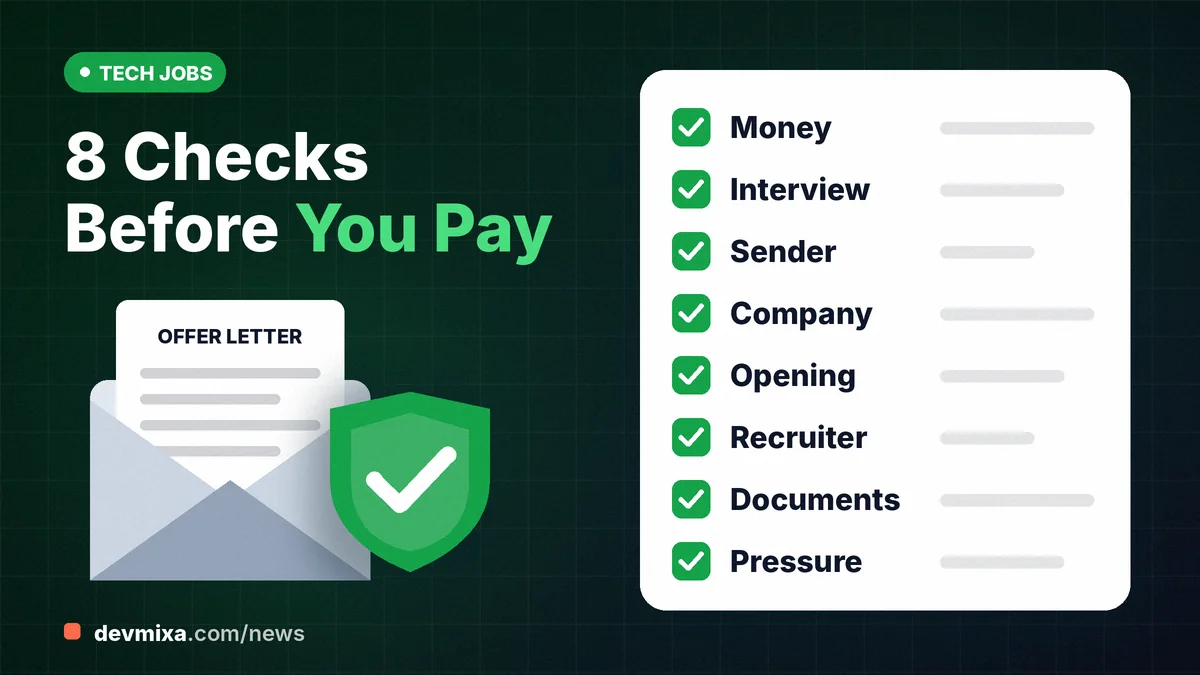
You can test any offer with eight quick checks, and a genuine one will pass all of them. Run them in order; the first three catch most scams.
- Money: Does anyone ask you to pay for registration, training, a laptop, a uniform, background verification or "document processing"? If yes, stop.
- Interview: Did you go through a real interview process, such as an aptitude test, technical round or HR call? An offer with no interview at all is a warning.
- Sender: Is the email from the company's own domain, or from Gmail, Yahoo or a look-alike address?
- Company: Does the company exist on the MCA portal with an active status?
- Opening: Is the same role listed on the official careers page of that company?
- Recruiter: Can you confirm the HR person through the company's published contact details?
- Documents: Are they asking for bank details, OTPs or original certificates before any verified offer?
- Pressure: Are you told to accept within hours, or to keep the offer secret?
Can an offer without any interview be genuine? Very rarely, and only when a known campus drive or referral already tested you. If nobody has seen your skills, nobody has hired you yet. Learning how to check fake job offer letter claims is mostly about asking these eight questions calmly instead of reacting to a deadline.
Fake job offer asking for registration fee: the first and loudest alarm
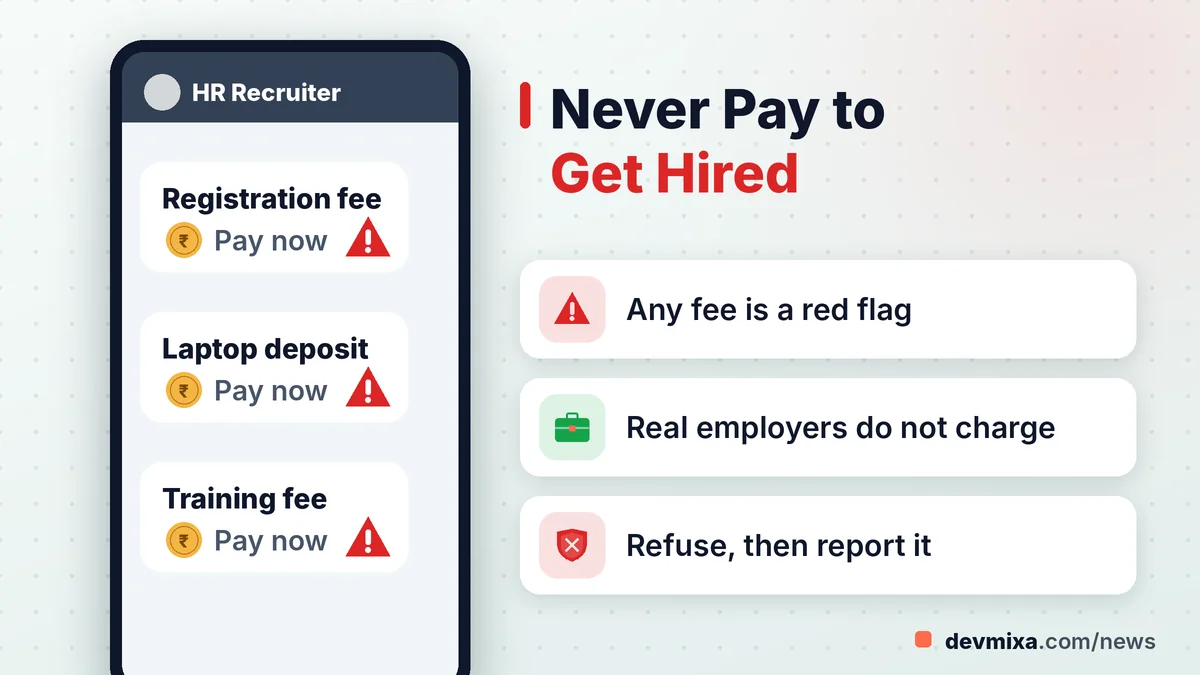
A fake job offer asking for registration fee money is the single clearest sign of fraud, because genuine IT employers in India do not charge candidates to hire them. The large firms say so in writing. Infosys states on its recruitment fraud alert page that it does not charge or accept any amount or security deposit from job seekers during recruitment, and it runs an offer validation facility for its India offers. The Tata group carries a similar disclaimer, saying Tata companies do not charge or accept money or a security deposit from applicants, and it asks candidates to check openings on its official careers site.
TCS freshers usually hear about the TCS NQT, the company's national qualifier test. The genuine route to TCS fresher roles runs through its official NextStep and iON platforms, so confirm any test details and terms there, never through a WhatsApp forward or a stranger's UPI payment link. Genuine firms do pay for your background verification through their own vendors.
So do genuine IT companies ever ask freshers to pay a fee to be hired? No. A recruiter who needs your money is selling a ticket to a train that does not exist.
Spotting the laptop security deposit job scam freshers India-wide are warned about
The laptop security deposit job scam freshers India-wide keep reporting has a simple shape: a "selection" message, then a bill. You are told you cleared the screening, often without a test, and that the company will courier a work laptop. Before dispatch, you must pay a refundable security deposit, sometimes a few thousand rupees, sometimes more. Once you pay, a second charge appears: insurance for the laptop, a software licence, a training fee for a mandatory course or a "background verification" charge. Each payment feels small; together they hurt.
The refund never comes because the laptop never existed. Real employers issue company assets after you join, record them in an asset register and recover them when you leave. They do not ask a candidate to finance the company's hardware before day one. Some add a twist: buy a course from a "partner institute" to qualify, where institute and employer turn out to be the same Telegram account.
Watch the language too: "refundable", "limited slots" and "pay today to lock your joining date" are pressure tools, not HR policy. If a deposit is mentioned at any stage before you sign a verified appointment letter, walk away.
Is a job offer from Gmail ID real or fake? Read the sender line first
The short answer: treat it as fake until proven otherwise. Established companies send recruitment mail from their own domain email, such as an address ending in the company's website name. Infosys, for example, says its recruitment emails come from @infosys.com addresses and warns that offers from Gmail or Yahoo accounts are likely scams. A tiny startup may use a free address early on; a large IT brand never needs one.
How to verify HR email domain of company senders
The check takes two minutes. Open the company's official website by typing the address yourself, not by clicking the link in the email. Compare the domain after the @ sign letter by letter. Watch for an extra hyphen or ".co" in place of ".com". Then find the contact page on the official site and forward the offer to that HR address asking whether it is genuine.
Checking the recruiter as a person
For a LinkedIn recruiter, check the profile's age, its connections at the same firm and whether the job appears on the company page. CERT-In, India's national computer emergency response team, regularly advises users to treat unexpected links and attachments as a possible phishing email. A fake offer PDF can carry exactly that risk.
How to verify company on MCA portal before joining
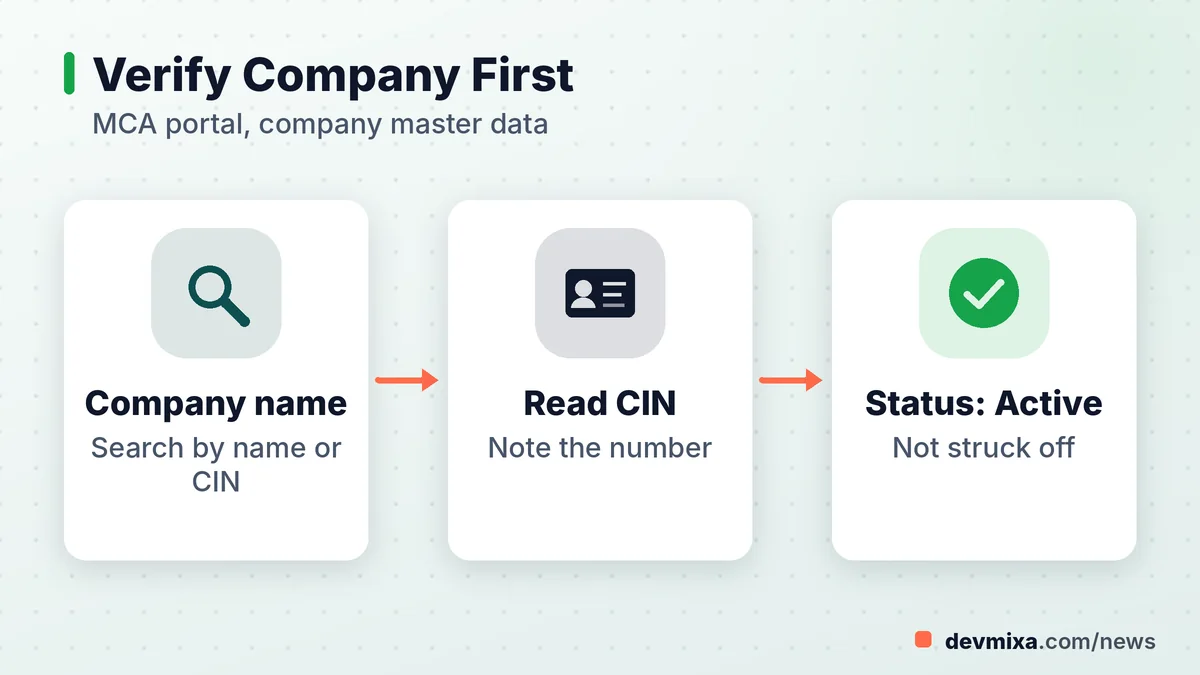
Search its name in the Ministry of Corporate Affairs company master data and check that the status reads Active. The MCA portal, built on MCA21, holds the official record of registered companies and LLPs.
- Open mca.gov.in and go to the MCA Services menu, then Master Data and the option to view company or LLP master data. The V3 portal may ask you to register and sign in first.
- Search by company name or by its CIN, and fill in the captcha.
- Read the result: company name, CIN number, date of incorporation, registered address, email and the company status.
The CIN is a 21-character code that every Indian company receives at incorporation. It begins with L for listed or U for unlisted companies and includes a state code and the year of incorporation. If the CIN on your letter does not match the master data, or the status shows "Strike Off" or "Under process of striking off", you have your answer.
Next, open the official careers page of the company and search for the exact role. If the role is not listed there, treat the offer as doubtful. Part of how to check fake job offer letter claims is simply calling the number on the website, not the one in the email.
Documents not to share before joining a company
The list starts with anything that moves money: bank details, cheque scans, debit card numbers, net banking passwords and OTPs. No employer needs your UPI PIN or a one-time password to hire you. Next come originals: show them at a verified document check, never courier them to a stranger.
Is it safe to share Aadhaar and PAN copies with a recruiter?
Share Aadhaar and PAN card copies only after the company and the offer are verified, and only through the employer's own onboarding portal or HR email. A scammer with your Aadhaar copy, PAN card copy, a selfie and your phone number can try to open accounts, take loans or create mule accounts in your name. If you must share an Aadhaar copy, use the masked Aadhaar option from UIDAI, which hides most of the number, and write the purpose and date across the copy, such as "for XYZ onboarding only".
Keep a simple rule: identity documents follow trust; they do not create it. Background verification is a genuine step, but it happens after an offer from a verified employer, and the employer pays for it.
The fake work from home job scam red flags India's cyber cells repeat most
The warning signs are easy to list and hard to resist when the first payout lands in your account. It starts on WhatsApp or Instagram with a message offering ₹2,000 to ₹5,000 a day for "simple online tasks". You like a few videos, receive a small reward and are moved into a Telegram group. There, the tasks change: now you must "prepay" to reach higher-paying jobs. This Telegram task scam is the commonest form of part-time job fraud, and the early payouts are bait to win your trust before larger deposits.
Red flags to remember:
- Pay that is far higher than the effort, with no contract or company name.
- A request to pay before you can withdraw your own "earnings".
- Group admins who change names, numbers and stories every week.
- Links to unknown apps or websites that show a balance you can never withdraw.
In December 2023, according to a PIB release, the IT ministry blocked over 100 websites linked to organised task-based part-time job and investment fraud after the Home Ministry's Indian Cyber Crime Coordination Centre (I4C) flagged them. For suspicious calls, SMS or WhatsApp messages where you have not lost money, use the Chakshu facility on the Department of Telecommunications' Sanchar Saathi portal. Chakshu is for reporting the message; it is not the place to report a financial loss.
What to do after paying money to fake recruiter accounts
Call 1930 at once. The 1930 helpline is the national cyber fraud number, linked to a system that alerts banks and payment firms so they can try to put a hold on the money before it moves again. Police and advisories call the first hours the "golden hour", because a fast complaint gives the best chance of freezing funds.
How to report job fraud on cybercrime.gov.in
Open the National Cyber Crime Reporting Portal, choose the option to report a financial fraud or other cybercrime, register with your mobile number and fill in the incident details. Add the UPI payment reference or bank transaction ID, the date and time, the scammer's numbers and email IDs, and screenshots of the chats and the offer letter. Note the acknowledgement number.
Refunds, FIRs and your bank
Can you get your money back? Sometimes, if funds are frozen in time, but nothing is guaranteed and recovery can take months. Inform your bank's official customer care in writing as well. Your complaint may be converted into an FIR, or you can visit your local cyber police station to file one, especially for large losses. For legal questions, confirm on the official portal or consult a lawyer.

A ten-minute verification routine for students and placement cells
The simplest answer to how to check fake job offer letter doubts is a routine you follow every time. Save this checklist and share it with your batch:
- Pause for one hour before replying to any offer, however urgent it sounds.
- Refuse any payment request, whatever it is called.
- Match the sender's domain with the company's official website.
- Search the company on the MCA portal and note its CIN and status.
- Find the same role on the official careers page.
- Call HR using the number on the official website.
- Share no bank details, OTPs or originals; send masked Aadhaar only after verification.
- Screenshot everything and keep the chat history.
- If you paid, call 1930 and file on cybercrime.gov.in the same day.
Colleges and placement cells can help a great deal. A training and placement officer can confirm whether a company actually visited the campus, check the offer against the drive list and contact the company's campus team directly. Some keep a shared list of fake domains reported by students, turning one person's bad experience into everyone's warning.
Small firms hiring developers can return the favour: post openings on an official careers page and mail from your own domain. For more hiring and career updates, browse our tech jobs news section.
Frequently asked questions
Does TCS or Infosys charge money for jobs?
No. Infosys says it does not charge or accept any amount or security deposit from job seekers, and the Tata group, which includes TCS, carries a similar disclaimer. Anyone asking you to pay in their name for a job, test result or joining kit should be treated as a fraudster and reported.
What is the cyber fraud helpline number in India?
The national cyber fraud helpline number is 1930. Call it as soon as you notice that money has left your account because of a scam. You can also file a complaint online on the National Cyber Crime Reporting Portal at cybercrime.gov.in, where you receive an acknowledgement number to track it.
Can a fake offer letter carry a real company logo?
Yes. Logos, signatures and letterheads are easy to copy, so a real logo proves nothing, which is why learning how to check fake job offer letter details matters. Judge the letter by what you can verify: the sender's domain, an interview you actually attended, the role on the official careers page and the company's status and CIN on the MCA portal.
Is a job application through a Google Form safe?
A Google Form by itself is not proof of fraud, since some small firms and colleges use them. The risk lies in what it asks for. If a form wants Aadhaar numbers, bank details, OTPs or a payment before any interview, close it. Apply on the company's own careers portal whenever one exists.
Can I verify an offer letter by calling the company?
Yes, and it is one of the strongest checks, provided you use the phone number or HR email listed on the company's official website. Never use the number printed in the suspicious letter, because it usually connects back to the scammer. Ask HR to confirm your name, the role and the offer reference.
How quickly should I report after losing money?
Report immediately, ideally within the first hour or two. Cyber police call this early window the golden hour, because a quick complaint on 1930 or cybercrime.gov.in lets banks try to hold the money before scammers move it through other accounts. Waiting a day lowers the odds.
Is a background verification fee ever legitimate?
For a job candidate, no. Background verification is a real hiring step, but the employer arranges and pays for it through its own vendor after making a genuine offer. If a recruiter asks you to pay a verification fee, an onboarding charge or a document processing cost, treat it as a scam.
Are job offers on Telegram ever real?
Treat them with deep suspicion. Some genuine communities share job links on Telegram, but the actual application should always lead to the company's official careers page. Offers made inside a Telegram group, especially ones paying for likes, reviews or tasks and later asking for deposits, follow the classic task scam pattern.
Can scammers misuse my Aadhaar copy?
They can try. With an Aadhaar copy, a PAN copy and your photo, fraudsters may attempt to open accounts, take loans or register SIM cards in your name. Share a masked Aadhaar only with verified employers, write the purpose on copies and check the Sanchar Saathi portal for mobile connections in your name.
Where can I check if a company is registered in India?
Use the Ministry of Corporate Affairs portal at mca.gov.in. Its company master data search shows the company's name, CIN, date of incorporation, registered address and current status. An active status means the company is registered, though it does not prove a job offer is genuine, so confirm the role with the company too.
Planning a website, web app or SEO upgrade?
Tell us what you need. We reply within one working day with a clear plan and price.