In this story11 sections
- When will November 2026 core update finish? Dates, scope and status
- November 2026 core update traffic drop recovery: what Yogesh saw on 10-12 sites
- Rankings fluctuating during core update rollout: trackers, forums and Reddit
- Early recovery after November 2026 core update: what a partial bounce means
- Core update or something else? Ruling out the ordinary causes of a drop
- November 2026 core update search console data: which date ranges to compare
- Which sites report losses so far: e-commerce, YMYL pages and scaled AI content
- Traffic up, enquiries down: reading a conversion drop after the update
- What to do while Google core update is rolling out, and what to leave alone
- November 2026 core update impact on small websites India: getting a second opinion
- Frequently asked questions
Monday morning, tea in hand, a shop owner opens Search Console and finds a cliff where last week's clicks used to be. That scene has become familiar since Google began rolling out its November 2026 core update on 10 November. This report looks at November 2026 core update traffic drop recovery on 10 to 12 websites reviewed mid-rollout. It also covers the numbers that deserve your attention and why patience beats panic until the update ends.
| At a glance | Details |
|---|---|
| What | Google's November 2026 core update, a broad ranking update and the third core update of 2026 |
| Who it affects | All sites in Google Search, in every region and language |
| Rollout began | 10:06 a.m. PT on 10 November 2026 (11:36 p.m. IST) |
| Expected length | Up to 2 weeks, per Google; still in progress as of 16 November 2026 |
| Where to check | Google Search Status Dashboard |
| Advice for now | Avoid bulk changes, fix only real faults, compare data a full week after the rollout completes |
When will November 2026 core update finish? Dates, scope and status
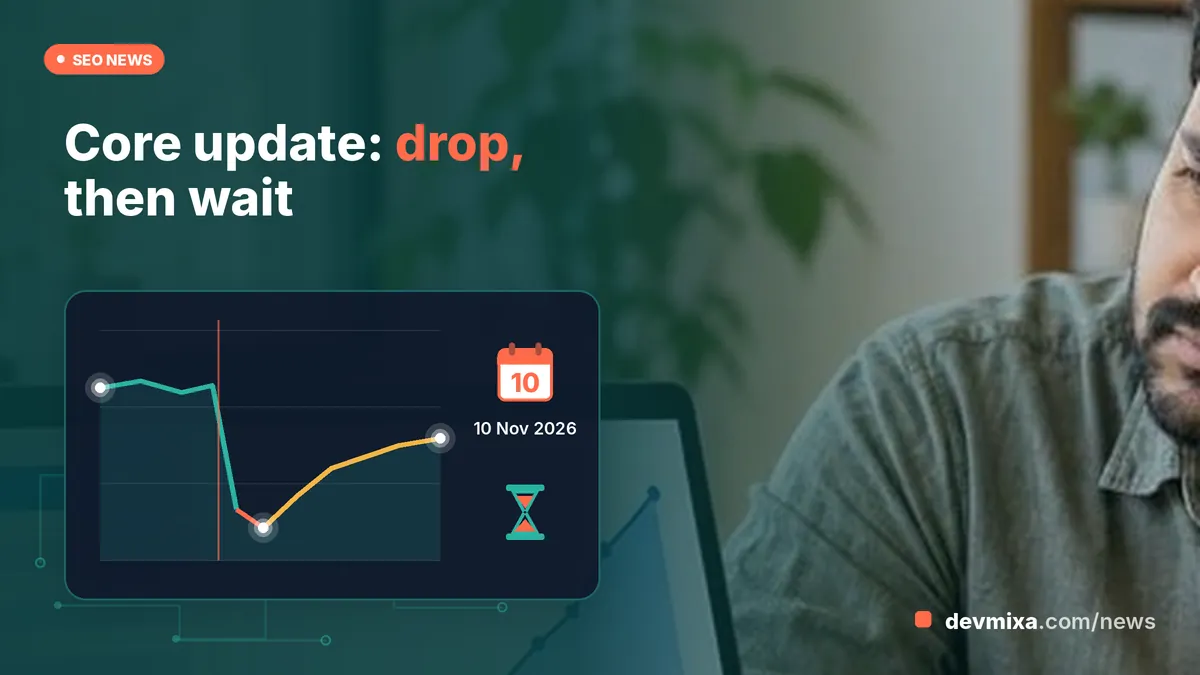
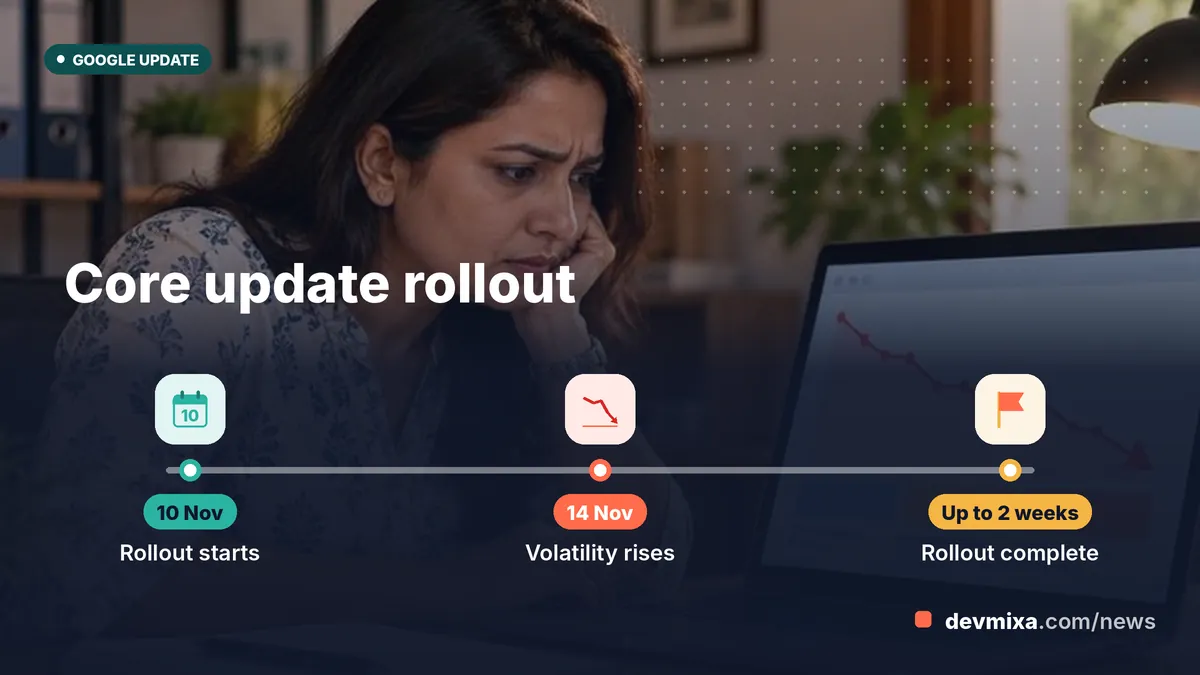
So when will November 2026 core update finish? Probably by about 24 November 2026, though it may end sooner, because Google has said only that the rollout could need as long as two weeks. It went live at 10:06 in the morning, Pacific time, on 10 November 2026, which was 11:36 p.m. IST that night, and it applies to all regions and languages.
Google's one-line explanation calls it a routine update meant to show more relevant, satisfying results drawn from every kind of site. There is no list of targets and no named signal.
This is the third broad core update of the year. Search Engine Roundtable lists the March 2026 core update as lasting from 27 March until 8 April, with May's running from 21 May until 2 June. Each closed in roughly 12 days, inside a two-week rollout window.
Is it still rolling out? As of 16 November 2026 the dashboard showed no completion post. If you read this later, check Google's status page for this rollout yourself. Google posts a brief completion update on that page once the rollout ends.
A core update behaves like monsoon water reshaping a riverbed: the current keeps moving for days, and nobody can map the new channel until it settles.
November 2026 core update traffic drop recovery: what Yogesh saw on 10-12 sites
Yogesh Kumar Dewangan, founder of Devmixa in Bhopal, has reviewed 10 to 12 websites since the rollout began, and his picture is mixed rather than grim. On some sites, traffic dropped after Google November 2026 core update changes began to show. On some of those same sites, traffic has since started to come back a little. Rankings moved both ways: some sites lost positions, while others gained rankings and traffic.
This is one practitioner's observation across a small group of sites, not a study. He has not shared percentages, site names or niches, and we have not added any. Still, it shows something worth remembering: the same update can push one site down and lift its neighbour in the same week.
"Since this update started, I have reviewed 10 to 12 websites. On some, traffic dropped, and on some of those it has started to recover a little. Some sites lost rankings, and some gained rankings and traffic."
"Do not make bulk changes to your site while the rollout is running, and do not panic. Wait for the rollout to finish, then compare your data properly. If you want expert help, call or WhatsApp us at Devmixa."
Yogesh Kumar Dewangan, founder, Devmixa, Bhopal

Rankings fluctuating during core update rollout: trackers, forums and Reddit
Yes, rankings fluctuating during core update rollout is normal. A keyword that jumps from position 6 to 14 and back to 9 inside a week is part of how these updates land. Ranking volatility trackers such as Semrush Sensor, Mozcast, Sistrix visibility charts and Algoroo follow large keyword sets and turn the daily churn into a single score. They show whether your wobble is personal or shared.
Barry Schwartz of Search Engine Roundtable reported that chatter and tool readings rose on Saturday, 14 November, about four days after launch. He also described the movement as fairly muted so far, and suggested a likely factor: blocks that stop some third-party tools from tracking Google's results.
The site-owner comments he gathered from WebmasterWorld, social media and his own comment section pull in every direction. One person described a small dip that recovered and then a weekend gain; another reported a fall of more than 20 percent against the previous week. These are single voices, not trends.
To follow practitioners comparing notes in real time, the r/SEO Reddit community and r/bigseo both host discussions during big updates. Treat them like the commentary box at a cricket match: lively and good for mood, but check the scorecard before you change your batting order.
Early recovery after November 2026 core update: what a partial bounce means
Early recovery after November 2026 core update losses is possible. Yogesh has seen a little of it on some sites that first lost traffic, but a bounce in the middle of a rollout is a reading, not a verdict. Because the update reaches search results gradually, a page can slide on day three, climb partly by day nine and settle somewhere else again once the rollout ends.
What does a partial bounce usually mean? The first drop may have been the shake of an update still in motion. Some pages may be holding while others lose ground, which averages into a softer line, or the rebound itself may fade. Only the final numbers will tell you which.
Can a site win back everything before the rollout is complete? It can regain some ground, but lasting change is slower. Google's core update guidance says its systems may take months to register improvements. If a few months pass with no effect, a site may have to wait for the next core update.
Think of a mid-rollout bounce as power returning after an evening cut. It is welcome, but keep the inverter on until the supply is steady.
Core update or something else? Ruling out the ordinary causes of a drop
A traffic drop belongs to the core update only if its timing matches the rollout and nothing else on your site changed in the same window. Start by clearing up one fear: a core update ranking drop is not a Google penalty. Google's own analogy is an updated list of the best restaurants, where a place that slips down is not necessarily bad, because others have earned a spot too. A real penalty is a manual action, and it appears by name in the Manual actions report of Google Search Console.
So why did your traffic fall? If the dip started on or after 10 November, and particularly around 14 November when volatility rose, the update is a fair suspect. Rule out the dull culprits first:
- A redesign, theme switch, migration or plugin update in the same fortnight
- Pages accidentally set to noindex, or a careless robots.txt edit
- Server downtime, slow hosting or an expired SSL certificate
- Broken analytics tags, which make traffic vanish only on paper
- A normal post-festive slowdown in demand for your category
If all of these check out and the decline spreads across many pages inside the rollout window, the update is the likelier cause. If a forum thread or an AI Overview now sits above you for a lost keyword, Google has changed how it ranks that query. Your website is not necessarily broken.
November 2026 core update search console data: which date ranges to compare
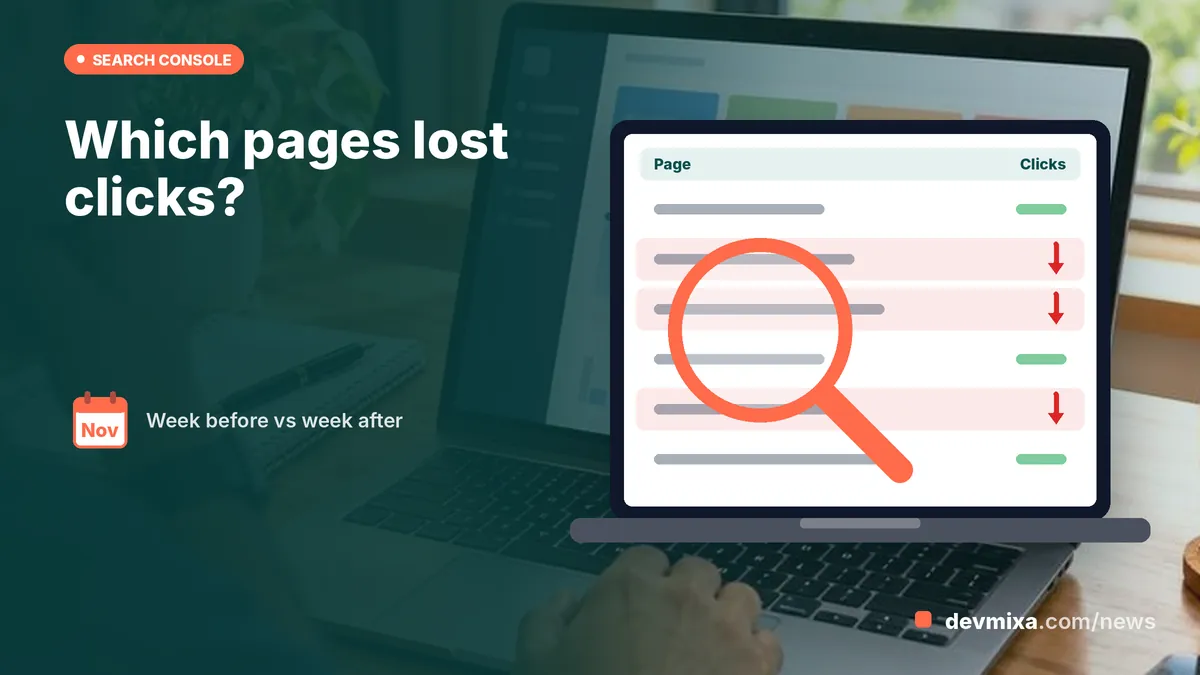
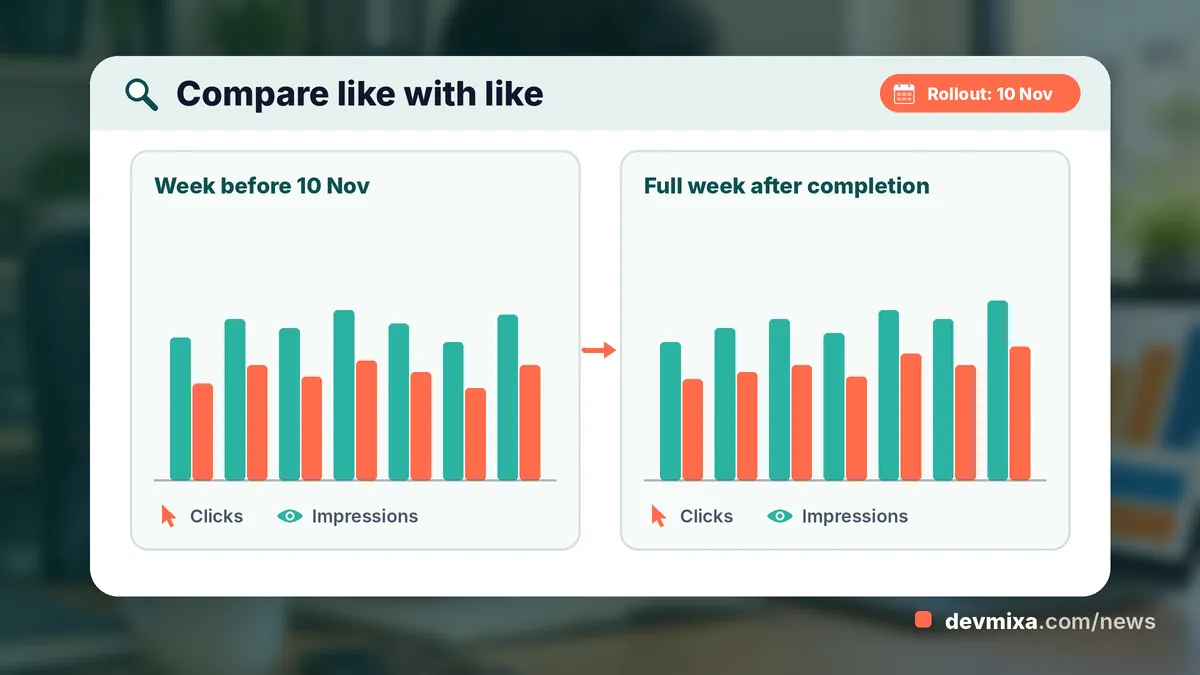
November 2026 core update search console data becomes reliable only after the rollout ends. The fair comparison is a full week after completion against the week before 10 November. That is Google's own method: confirm the update has finished, wait at least a full week, then compare. If the rollout were to close on 24 November, for example, you would compare roughly 2 to 8 December with 3 to 9 November.
To set it up in the Google Search Console performance report:
- Open Performance, then Search results, then Date, and choose Compare.
- Pick custom ranges: the week before the update against a full week after completion.
- Show organic clicks, impressions, click-through rate and average position.
- Add a query filter that excludes your business name, so non-branded queries reveal the true effect.
- Open the Pages tab and sort by the change in clicks to see which URLs moved most.
Why does the data feel stale right now? Search Console always runs a little behind, and Barry Schwartz reported that its performance reporting has been lagging during this period. One site owner he quoted saw odd impression and click-through spikes on normally quiet pages over 48 to 72 hours. The newest, partial days on any chart are the least trustworthy, so never call a drop on yesterday's figures.
Which sites report losses so far: e-commerce, YMYL pages and scaled AI content
No official list of winners and losers exists, because Google never publishes one. What exists so far are early, anecdotal reports. One owner quoted by Search Engine Roundtable said articles, filter pages and product pages from the same site had replaced its e-commerce category pages, at lower positions. Someone in a YMYL category, covering topics such as health and money, said informational pages were crowding the top 20 results ahead of stronger commercial pages.
Does the update target AI-generated content? Google has not said so, and its announcement speaks only of better results from all kinds of sites. On 16 November, Glenn Gabe pointed on X to two domains, flagged by another SEO, that were dropping sharply and had grown through scaled AI content. That is an early observation about two sites, not a rule.
Google's helpful content guidance and the E-E-A-T idea still frame the question well. A page that a knowledgeable author wrote for a real reader tends to age better than one written to fill a keyword sheet. For YMYL sites, author details, sources and current facts deserve a review once the dust settles.
Search Engine Roundtable also notes that core updates affect Google Discover traffic. It adds that Google uses core ranking signals in its AI experiences, which include AI Overviews and AI Mode. Visibility there can shift alongside the ordinary blue links.
Traffic up, enquiries down: reading a conversion drop after the update
Rising traffic with falling sales usually means Google is now sending you visitors with a different intent. One site owner quoted by Search Engine Roundtable said rankings and traffic were improving but conversions were not; another said conversions disappeared on a single day. Both are lone reports.
Take a hypothetical coaching institute whose blog post on an exam syllabus suddenly ranks for broad reading searches. Visits climb. Calls do not. The newcomers are students browsing, not parents ready to enrol, while the admissions page that used to rank for fee-related searches has slipped a few places.
To find out what is going on:
- In Search Console, compare queries before and after. Are the new clicks informational ("what is", "how to") rather than commercial ("fees", "near me", "price")?
- In your analytics tool, look at conversions by landing page instead of the site-wide total.
- Test your forms, WhatsApp buttons and payment pages, because a broken form looks exactly like a conversion drop.
A conversion drop during the rollout is a reason to watch closely, not to rewrite your service pages tonight.
What to do while Google core update is rolling out, and what to leave alone
What to do while Google core update is rolling out comes down to watching carefully and fixing only genuine faults. Should I make changes during core update rollout? For bulk changes, Yogesh's answer is no, and Google's guidance agrees. It warns against quick fixes and, after a small drop, against drastic changes, especially to content that is already doing well.
A practical checklist for the next two to three weeks:
- Bookmark the dashboard entry and check it daily for the completion note.
- Export top pages and queries for 3 to 9 November from Search Console, so you hold a fixed baseline.
- Keep a dated change log of every edit, plugin update and new page.
- Fix only real breakages: broken forms, server errors, missing key pages, accidental noindex tags.
- Pause mass rewrites, bulk deletions, URL changes and site-wide redirects. Google calls removing content a last resort.
- Leave the disavow tool alone. Google intends it for sites whose spammy links have triggered, or will probably trigger, a manual action.
- A full week after completion, run the comparison, then plan improvements page by page with the reader in mind.
If your site handles payments, health or legal information, confirm the latest advice on Google's official pages or consult a qualified professional before major changes.
November 2026 core update impact on small websites India: getting a second opinion
The November 2026 core update impact on small websites India-wide will depend less on size and more on how well each page serves its searchers. Google says the update covers all types of sites and every language, but small sites feel a drop more sharply. A hypothetical Bhopal clinic with 40 pages may get most of its enquiries from five of them. One slipped page can mean a quiet phone for a week.
Bhopal small businesses that rely on map listings should also remember that Google names relevance, distance and prominence as the main factors for local results. A tidy Business Profile and genuine reviews can soften the blow while the website recovers.
If your traffic dropped and you would like someone to read the numbers with you once the rollout ends, Devmixa offers a core update review. You can call +91-6263243441, message us on WhatsApp Devmixa, or write through the contact page. There is no need to rush. The most useful review starts with a full week of post-update data, and sometimes its honest conclusion is that waiting is the right move.
For more coverage of Google changes that affect Indian websites, browse the Devmixa news section.
Frequently asked questions
Will disavowing links help me recover from a core update drop?
Usually not. Core updates reassess how relevant and useful content is, and Google's core update guidance does not mention disavowing at all. Google reserves the disavow tool for sites with many spammy or artificial links that have led, or will probably lead, to a manual action.
Which mistakes should site owners avoid during the rollout?
The common ones are mass rewriting content, deleting dozens of pages, changing URLs, buying links, and treating yesterday's Search Console figures as final. Each one muddies your data, so you cannot separate what the update did from what you did. Keep a change log, fix only genuine faults, and wait for the completion note.
Can a core update change my Google Discover visits?
Yes. Search Engine Roundtable notes that core updates affect Discover as well as normal search results. If Discover clicks fall, open the Discover report in Search Console separately from the search results report, and judge it over several weeks rather than a few days.
How does this update differ from the March and May 2026 core updates?
Google has not described any specific difference. All three are broad core updates with the same stated aim of surfacing relevant, satisfying content. March's lasted from 27 March until 8 April and May's from 21 May until 2 June, about 12 days each. November's began on 10 November with a window of up to two weeks.
Do core updates hit small Indian business websites differently?
Google applies core updates globally and in all languages, so Indian sites are judged by the same systems as everyone else. The difference is exposure. A small site often depends on a handful of pages for its leads. Losing a few positions on those pages can quickly mean fewer calls, messages and enquiries.
Can a local service business in Bhopal lose rankings in a core update?
It can, but not automatically. Its website pages can move like any other site's. Google names relevance, distance and prominence as the main local factors, so a well-kept Business Profile with genuine reviews often cushions the effect. Check both your website pages and your local listing before drawing any conclusions about the update.
How long does recovery from a core update drop usually take?
There is no fixed timetable. Some sites see movement within weeks of making genuine improvements, but Google says its systems can take months to register the change. Some sites recover meaningfully only at a later core update, and some never return to old levels because stronger pages now hold those positions.
Do I have to wait for the next core update to recover fully?
Not always. Google says it makes smaller core updates between the announced ones, so improvements can show up sooner. Google also says that if a few months pass with no effect, recovery may have to wait for the next broad core update.
What should I do after the November 2026 rollout finishes?
Wait a full week after Google posts the completion note, then compare that week with the week before 10 November in Search Console. List the pages and queries that lost or gained most, study the pages now ranking above yours, and improve your content wherever readers are clearly better served elsewhere.
When does it make sense to hire an SEO agency after a drop?
Consider outside help when a large drop persists a week or more after the rollout ends, or when leads and sales fall with it. It also helps when you cannot tell whether a migration, a technical fault or the update caused the drop. Ask any agency to explain its reasoning with your own data, and avoid anyone promising guaranteed recovery.
Planning a website, web app or SEO upgrade?
Tell us what you need. We reply within one working day with a clear plan and price.